


At a Glance: Correct BESS sizing for off-grid sites comes down to five numbers — daily energy, peak demand, autonomy days, depth of discharge, and temperature derating. This guide walks through a proven step-by-step method with real numbers, a full Saudi mining camp case study, and a free configurator that automates the entire process.
Getting BESS sizing off-grid wrong is expensive in two directions. Undersize the battery and the site suffers blackouts, damaged equipment, and emergency diesel burn at premium prices. Oversize it and you lock up capital in lithium cells that sit idle for years. Off-grid battery sizing is not guesswork — it is a repeatable engineering process any site manager or project engineer can follow.
This guide walks through a proven step-by-step method for BESS sizing off-grid, from building a load inventory to validating with simulation. Every step uses real numbers, and a complete Saudi mining camp case study ties it all together. Along the way we introduce the free PORTA Microgrid Configurator, which automates the whole process in about five minutes.
Every sizing exercise starts with one question: how much energy does the site actually consume? Without an accurate load inventory, every downstream calculation inherits the error.
List every electrical load on site: motors, pumps, lighting, HVAC, telecom equipment, workshop tools, kitchen and accommodation. Record the rated power in kW for each item.
For each load, estimate hours per day of operation. Multiply power by hours to get daily energy in kWh, then aggregate everything into a 24-hour profile showing:
| Load Type | Power (kW) | Qty | Hours/Day | Daily Energy (kWh) |
|---|---|---|---|---|
| Water pump | 11 | 2 | 8 | 176 |
| Accommodation lighting | 0.02 | 200 | 12 | 48 |
| HVAC / AC | 3.5 | 6 | 10 | 210 |
| Workshop & tools | 8 | 1 | 6 | 48 |
| Kitchen / catering | 6 | 1 | 6 | 36 |
| Total | — | — | — | 518 |
Motor loads deserve special attention: inrush current on starting can be 5–7× rated power. For a detailed treatment of pump and motor starting behaviour in hybrid systems, see our Solar-Storage-Diesel Microgrids for Motor Loads guide.
Two parameters define how much buffer your site needs.
Autonomy is the number of days the BESS must supply the site without any solar or diesel input — typically sized around the worst-case weather window. Recommended starting points:
| Site Type | Autonomy Days |
|---|---|
| Construction / mining camp | 2–3 |
| Oil & gas field | 3–4 |
| Remote telecom tower | 5–7 |
| Critical process / water | 3–5 |
DoD is how much of the rated capacity you actually use before recharge. Lithium-ion cells are typically operated at 80% DoD — deeper discharges accelerate cycle ageing and shorten service life. The relationship is roughly exponential: every 10% deeper discharge can cut cycle life by roughly 20–30%. Using 80% DoD as a conservative default balances usable capacity against a 10+ year service life.
The core formula is simple:
Required BESS capacity (kWh) = (Daily energy × Autonomy days) ÷ Depth of Discharge
Take a site consuming 100 kWh/day with 3 days autonomy and 80% DoD:
100 kWh × 3 days ÷ 0.80 = 375 kWh
That 375 kWh is the theoretical minimum. In practice you add a safety margin of 10–20% to cover measurement error and load growth:
375 kWh × 1.15 = 431 kWh → round up to a 450–460 kWh bank
Ambient temperature changes usable capacity. In Saudi Arabia’s desert heat, a lithium battery rated at 25 °C delivers noticeably less usable energy at 45 °C unless thermal management is active. PORTA’s Mobile BESS includes active cooling, but a derating factor should still be applied in sizing (see Step 7).
A BESS almost never works alone. In a hybrid microgrid, solar PV and a diesel generator share the load with the battery — and that changes the sizing math.
During daylight hours, PV supplies the load directly and charges the battery. Only the net energy shortfall at night must come from storage. A site with strong solar generation can reduce its BESS requirement by 40–60% compared with a battery-only design.
The generator is the safety net: it covers prolonged cloudy periods and provides low-cost backup. In a well-designed hybrid, diesel run-time drops to 10–30% of the year — that is where the fuel savings come from. The battery is sized for the daily cycle, while the generator handles the extreme tail.
PORTA’s Hybrid ALL IN ONE integrates foldable solar, battery storage and a diesel generator in a single container — the same architecture the Configurator models when you select a hybrid topology.
Doing all of this by hand is fine for one site. For a fleet of sites, the free PORTA Microgrid Configurator automates every step:
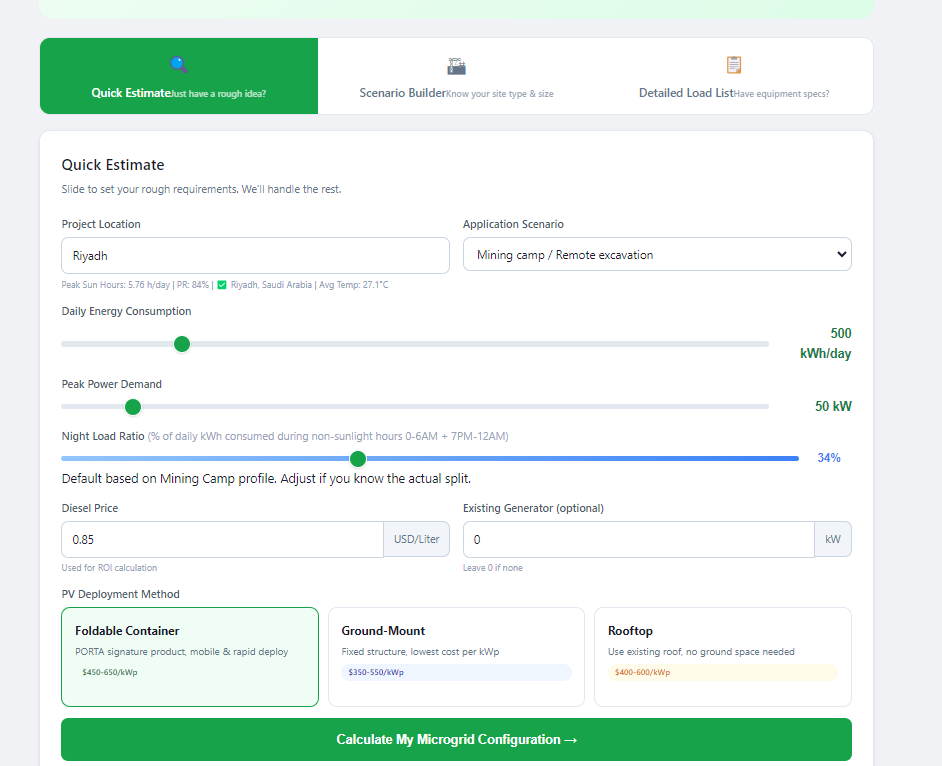
The result is a recommended system with a 24-hour energy flow simulation, diesel savings analysis, 10-year cash flow and a downloadable PDF proposal.
Hand calculations give you a starting point; simulation gives you confidence. Industry-standard tools include HOMER (homerenergy.com) and PVsyst (pvsyst.com), which model the system hour-by-hour across a full year.
Validation checklist:
PORTA’s engineering team performs full-year simulations for clients during project design — the Configurator output feeds directly into this workflow.
| Operating Temperature | Typical Capacity Derating |
|---|---|
| 25 °C (nominal) | 100% |
| 35 °C | ~95% |
| 45 °C | ~85–90% (with active cooling) |
| 0 °C (charging) | ~90% |
BESS capacity fades over time. A typical lithium bank retains ~80% of nameplate capacity after 4,000–6,000 cycles. Size for end-of-life capacity, not day-one capacity, or the system falls short of autonomy in year 8. Adding a 10–20% degradation buffer at design time is standard practice.
Use cells and packs certified to IEC 62619 (industrial battery safety) with thermal management and a battery management system (BMS). In high-heat climates, active cooling is not optional — it directly determines calendar life.
| Mistake | Why It Hurts | Fix |
|---|---|---|
| Ignoring load peaks | Inverter/controller undersized → tripping | Size power from peak kW, energy from kWh |
| Underestimating autonomy | Blackouts in cloudy weeks | Use 2–7 days depending on site criticality |
| Forgetting temperature | Capacity shortfall in summer | Apply derating factors (Step 7) |
| Oversizing to be safe | 15–30% wasted capital | Size to end-of-life with a 10–20% margin, not 50% |
| Using rated kWh as usable | System falls short of autonomy | Divide by DoD (80%) |
The common thread: use real load data. Estimates compound; measurements don’t.
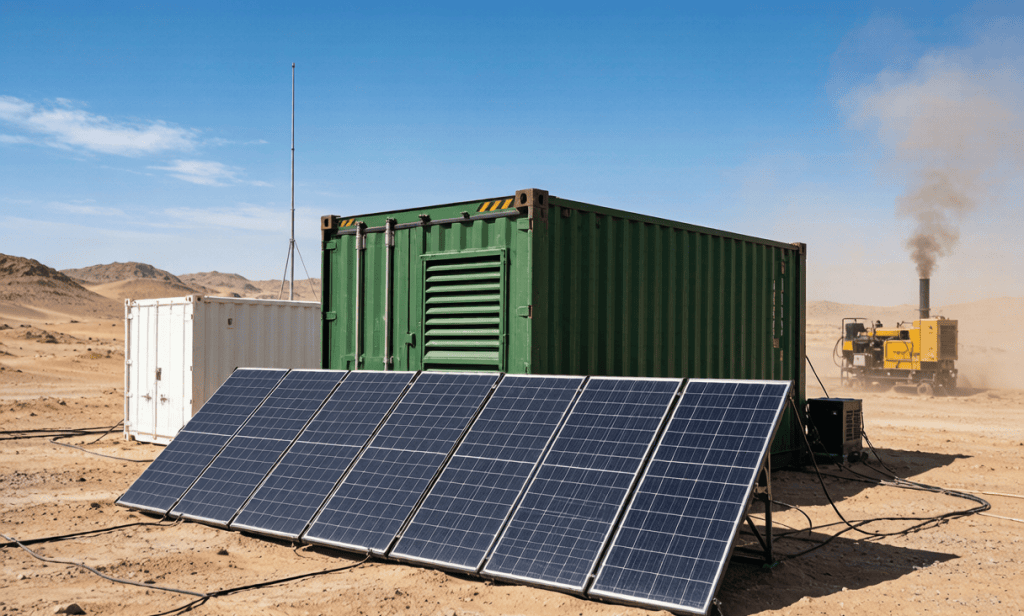
A mining contractor in the Riyadh region needs power for a 120-person exploration camp: water supply, lighting, HVAC, workshop and catering.
Step 1 — Load inventory: 518 kWh/day total (from the template above), 92 kW peak.
Step 2 — Autonomy & DoD: 2.5 days autonomy (weekly logistics), 80% DoD.
Step 3 — Capacity:
518 × 2.5 ÷ 0.80 = 1,619 kWh theoretical
1,619 × 1.15 (margin) ≈ 1,860 kWh
Step 4 — Solar integration: With strong desert solar resource (Riyadh ≈ 5.7 peak sun hours), PV covers most daytime load, cutting the storage requirement by ~55%:
| Parameter | Value |
|---|---|
| Daily energy | 518 kWh/day |
| Peak demand | 92 kW |
| Autonomy | 2.5 days |
| BESS (theoretical) | 1,619 kWh |
| BESS (with solar + margin) | ~830–900 kWh |
| PV recommendation | ~100–120 kWp |
| Estimated diesel savings | 60–75% |
Running the same inputs through the PORTA Configurator returns a matched package — foldable solar container + mobile BESS + generator — with the 24-hour simulation, payback analysis and PDF proposal ready in minutes. The result eliminates most fuel logistics while keeping the generator as a guaranteed backup.
BESS sizing off-grid comes down to five numbers: daily energy, peak demand, autonomy days, DoD and derating. Get those right and the battery serves the site for a decade. Get them wrong and you pay for it every month — in fuel, in blackouts, or in idle capital.
PORTA designs and delivers foldable solar containers, mobile BESS and Hybrid ALL IN ONE systems for mining, construction, oil & gas, telecom and water projects across Saudi Arabia and the wider Middle East.
Try the free Microgrid Configurator or contact our engineering team for a tailored off-grid power solution.
Launch the Free Configurator →For questions or a detailed engineering review, contact the PORTA team at jayden@solarstoragediesel.com.
Required BESS capacity (kWh) = (Daily energy consumption × Autonomy days) ÷ Depth of Discharge. Add a 10–20% margin for safety and degradation.
Typical autonomy ranges from 2–3 days for construction sites to 5–7 days for critical telecom infrastructure. Choose based on how often fuel and logistics arrive and how critical uptime is.
Yes. High ambient temperatures reduce battery capacity and lifespan. Apply a derating factor (e.g., ~85–90% at 45 °C) and size for end-of-life capacity.
Yes. The PORTA Microgrid Configurator is free to use and gives instant sizing recommendations, 24-hour simulation, diesel savings analysis and a PDF proposal based on your inputs.
Get a customized technical proposal and pricing for our mobile energy solutions.
Tell us about your requirements and we’ll build a solution.
Ask me anything about solar-storage-diesel hybrid microgrids!