


30-Second Summary: Induction motors draw 6-7x rated current on startup, forcing diesel generators to be oversized 2-3x. A solar-storage-diesel hybrid microgrid with BESS peak shaving and EMS load sequencing cuts generator capacity by 40-60%, eliminates voltage dips, and reduces fuel consumption 50-80%.
Mining camps, oil drilling sites, concrete batching plants, and agricultural pumping stations share one thing in common: their dominant loads are induction motors. Pumps, compressors, conveyors, crushers, fans, and drilling equipment all rely on three-phase induction motors—and these motors behave very differently from resistive loads like lighting or heating.
In a conventional diesel-only system, motor loads force generators to be oversized by 2-3x their running power just to survive startup transients. The result: generators that run at 20-30% load most of the time, burning fuel inefficiently, accumulating carbon deposits, and requiring frequent maintenance.
When a three-phase induction motor starts direct-on-line (DOL), it draws locked-rotor current (LRA) that is typically 6-7 times its full-load current (FLA). This inrush lasts 3-10 seconds until the rotor accelerates to near-synchronous speed.
During this transient:
The table below shows how starting method affects transient kVA demand:
| Starting Method | Current (x FLA) | Starting kVA (37kW motor) | Required Gen kVA | Cost Impact |
|---|---|---|---|---|
| Direct-On-Line (DOL) | 6.0x | 261 kVA | 700 kVA | Baseline (most expensive) |
| Star-Delta (Y/Delta) | 3.5x | 152 kVA | 563 kVA | -20% generator cost |
| Soft Starter | 3.0x | 130 kVA | 500 kVA | -28% generator cost |
| VFD | 1.5x | 65 kVA | 450 kVA | -36% generator cost |
Key takeaway: specifying a VFD on the largest motor can reduce the required generator from 700 kVA to 450 kVA—a saving of 250 kVA in capital cost. But VFDs alone don’t solve the whole problem.
Traditional engineering practice sizes generators for worst-case motor-starting, not running load. A site with 200 kW of running motor load might require a 600-800 kVA generator simply to survive the largest motor start.
This creates a cascading inefficiency:
The 30% rule (NFPA 110, ISO 8528-1) states that diesel generators should never operate below 30% of rated kW for extended periods. Yet in motor-heavy applications, this rule is violated daily.
A Battery Energy Storage System (BESS) solves the motor-starting problem at its root. Instead of oversizing the generator for a 5-second transient, the BESS provides the inrush current in milliseconds, allowing the generator to be sized for running load—not starting load.
Three mechanisms make this work:
When a motor starts, the BESS detects the load step within 1-2 milliseconds and discharges at high C-rate to cover the difference between motor inrush and generator output. The generator never sees the full transient—it only experiences a smooth ramp-up to the motor’s running load.
Example: A 75kW water pump with DOL starting draws ~450 kVA for 5 seconds. A 60kW diesel generator alone would trip or suffer severe voltage dip. With a 129 kWh BESS providing 140A maximum discharge current, the battery covers the 390 kVA gap instantly, and the generator only sees the 75 kW running load.
Modern hybrid inverters with grid-forming (GFM) capability can establish voltage and frequency reference independently of the generator. This means the inverter, not the generator alternator, sets the bus voltage during motor starts—bypassing sub-transient reactance limitations entirely. Voltage dip can be held under 5% even with DOL starting, compared to 15-35% with generator-only systems.
During motor starting, power factor drops to 0.15-0.30. The BESS inverter can supply reactive power (VARs) directly, offloading the generator’s alternator. This is critical because generator alternators are kVA-limited, not kW-limited—a 75 kVA generator cannot deliver 75 kW at 0.3 power factor.
The Energy Management System (EMS) is the brain that orchestrates PV, BESS, and diesel generator to handle motor loads efficiently. A well-designed EMS implements the following layered strategy:
| EMS Layer | Response Time | Function | Motor Load Benefit |
|---|---|---|---|
| Fast frequency response (FFR) | 1-5 ms | Inverter injects/absorbs power to hold 50/60 Hz | Absorbs motor inrush, prevents frequency dip |
| Voltage regulation | 1-5 ms | Inverter adjusts reactive output to hold bus voltage | Prevents voltage dip below 80% during DOL starts |
| Peak shaving | 10-100 ms | BESS discharges when load exceeds generator threshold | Generator stays in 60-80% efficient zone |
| Generator dispatch | 5-30 sec | EMS starts/stops generator based on SOC and load forecast | Eliminates wet stacking, reduces runtime 40-60% |
| Load sequencing | 1-10 sec | EMS staggers motor starts, sheds non-critical loads | Prevents simultaneous inrush from multiple motors |
The ‘sweet spot’ strategy locks the diesel generator into a 60-80% loading band. When motor load drops below 60%, the BESS absorbs excess generation to charge the battery. When motor load spikes above 80%, the BESS discharges to fill the gap. The generator never sees the transient.
The most effective architecture combines four technologies in a layered defense against motor-starting transients:
| Layer | Technology | Inrush Reduction | Additional Benefit |
|---|---|---|---|
| Layer 1 | VFD on largest motors | 6.0x -> 1.5x FLA | 30-50% energy savings on variable-torque loads (pumps, fans) |
| Layer 2 | Soft starters on medium motors | 6.0x -> 3.0x FLA | Lower cost than VFD, reduces mechanical stress |
| Layer 3 | BESS peak shaving | Covers remaining inrush gap | Allows generator downsizing by 40-60% |
| Layer 4 | EMS load sequencing | Prevents simultaneous starts | Staggered starting: largest motor first, then cascade |
With all four layers active, a site with 200 kW of motor load can operate reliably with a 100-150 kW generator + 100-150 kW BESS, instead of the traditional 600+ kVA generator-only approach. Fuel consumption drops 50-80%.
A mining site in Zimbabwe demonstrates this approach in practice:
| Parameter | Before (Diesel Only) | After (PV+BESS+DG Hybrid) |
|---|---|---|
| Power source | Single 600 kVA diesel generator | 600 kVA DG + 800 kWp PV + 1000 kW/1290 kWh BESS |
| Key loads | Stone cutters, crusher, camp power | Same loads, unchanged |
| Motor starting | Severe voltage dips, frequent trips | BESS delivers instant inrush, zero trips |
| Generator runtime | 24/7 continuous | Reduced ~60% |
| Fuel consumption | Baseline | ~50-65% reduction |
| Power quality | Voltage dips >20% during crusher starts | Voltage dip <5%, frequency stable |
| Maintenance | Frequent (wet stacking, carbon buildup) | Reduced 30-60% |
The BESS eliminated voltage dips entirely by delivering instant inrush current for the crusher and cutters. The generator was no longer the first responder—it became a strategic backup that ran only when battery SOC was low or during nighttime peak demand.
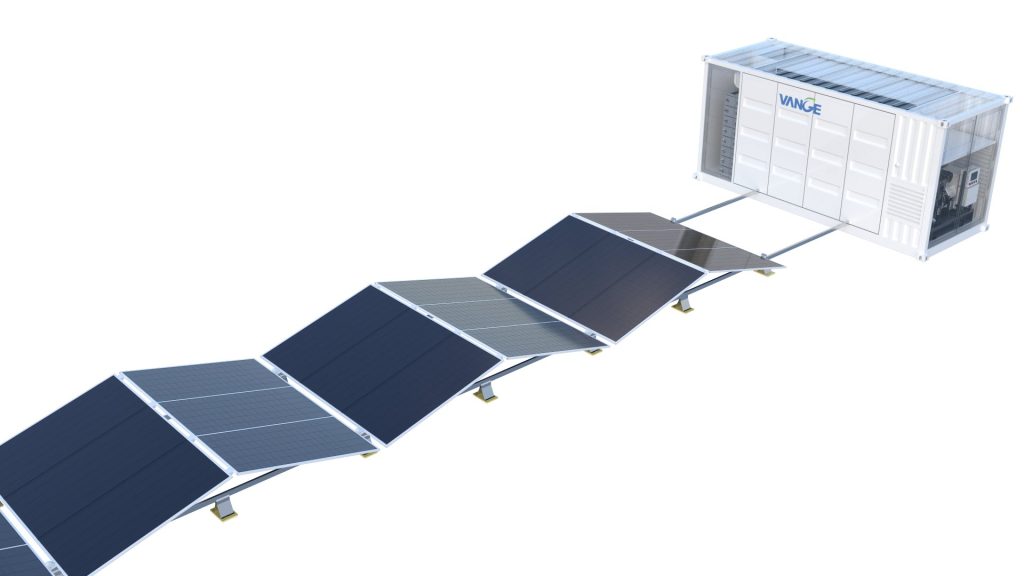
Underground and open-pit mining operations run crushers, conveyors, and ventilation fans continuously. These are high-inertia motor loads with frequent starts and stops. The PORTA ALL IN ONE container (78kWp PV + 60kW inverter + 129 kWh BESS + 75kW DG) handles a typical mining camp load profile:
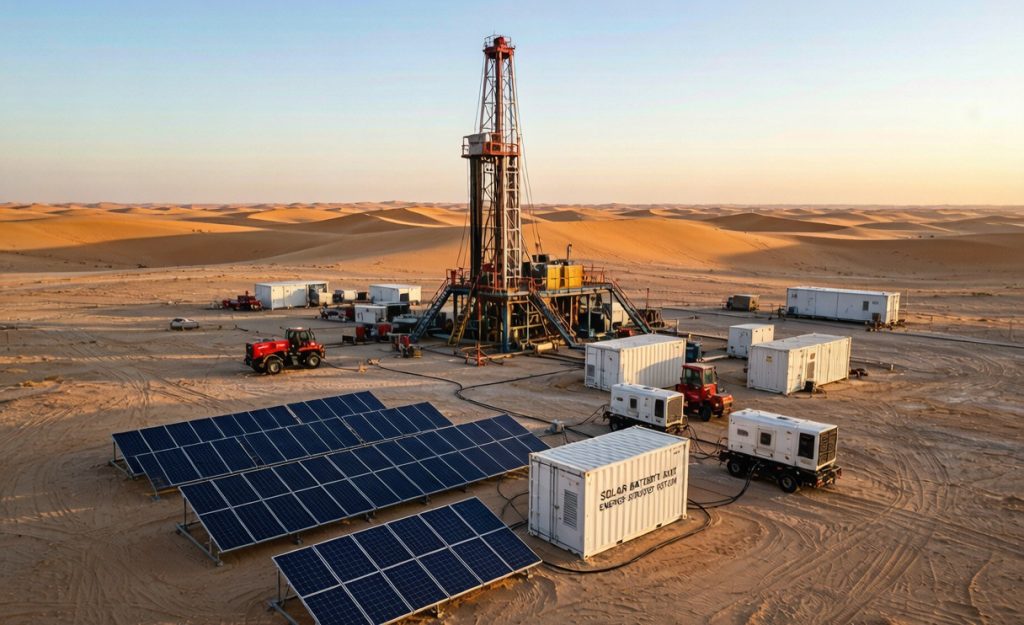
Drilling rigs operate mud pumps (300-800 kW), drawworks, and rotary tables—all large induction motors with cyclic load profiles. The BESS serves double duty: absorbing mud pump inrush during tripping operations, and smoothing the 2-3x load swings between drilling and tripping modes.
Batching plants run mixer motors (30-75 kW), conveyor belts, and aggregate crushers in cyclic operation—15-20 motor starts per hour. Traditional setups use oversized generators (250+ kVA) that idle at 30% load between batches. With PORTA hybrid: BESS handles every motor start, generator runs only when battery SOC drops below 30%. Typical fuel savings: 60-70%.
Deep-well irrigation pumps (30-110 kW) are the most common motor load in Saudi agriculture. They start 2-6 times daily and run for 4-8 hours per cycle. The PORTA foldable PV container directly powers the pump during daytime, with BESS covering starts and providing 1-2 hours of post-sunset pumping.
| Component | Specification | Motor Load Relevance |
|---|---|---|
| PV Capacity | 78 kWp (120 x 650Wp LONGi modules) | Powers running motor load during daytime |
| Inverter (PCS) | 60 kW / 66 kVA max, 400V 3-phase | Grid-forming, supplies reactive power for motor starting |
| Max output current | 95.7 A | Covers DOL inrush for motors up to ~45 kW directly |
| Battery (BESS) | 128 kWh LFP, 409V nominal | Peak discharge 140A = ~100 kVA instantaneous for 30+ seconds |
| Diesel Generator | WEICHAI WPG66-16, 75 kVA PRP / 60 kW | Backup only; sized for running load, not starting kVA |
| EMS | PORTA integrated, multi-mode | Load sequencing, peak shaving, SOC management |
| Container | 20ft HC (6058x2438x2896 mm) | Single-unit transport, <2 hour deployment |
For sites with motors larger than 55 kW, PORTA recommends pairing the ALL IN ONE with a VFD on the largest motor and/or adding a second Mobile ESS unit (100-250 kW / 258-723 kWh) for additional peak power capacity.
Follow this step-by-step process to determine the right hybrid system configuration:
Step 1: List all motor loads
| Load | Rated kW | Starting Method | Start Frequency | Running PF |
|---|---|---|---|---|
| Crusher motor | 55 kW | DOL | 5-10 starts/hour | 0.85 |
| Conveyor motor | 15 kW | DOL | 3-5 starts/hour | 0.82 |
| Water pump | 30 kW | Star-Delta | 2-3 starts/hour | 0.85 |
| Ventilation fan | 22 kW | VFD | Continuous | 0.90 |
| Camp power (resistive) | 25 kW | N/A | Continuous | 1.00 |
Step 2: Calculate worst-case starting kVA
Worst case = crusher starts while all other loads are running:
Step 3: Size the BESS to cover the gap
If generator = 75 kVA (running load + margin):
Step 4: Verify generator loading stays in 60-80% sweet spot
The traditional approach to motor loads in off-grid systems—oversizing generators for starting kVA—creates a cascade of inefficiencies: higher capital cost, chronic underloading, wet stacking, excessive fuel consumption, and frequent maintenance.
Solar-storage-diesel hybrid microgrids flip this paradigm:
For remote industrial sites in Saudi Arabia and the broader MENA region—where fuel logistics are expensive, solar resources are world-class, and motor loads dominate the power profile—this architecture delivers proven 50-80% diesel savings while improving power quality and equipment longevity.
Share your motor inventory, starting methods, and duty cycles. We will design the right hybrid configuration with ROI analysis within 48 hours.
Email: jayden@solarstoragediesel.com | WhatsApp: +966 539412006 | Riyadh, Saudi Arabia
Get a customized technical proposal and pricing for our mobile energy solutions.
Tell us about your requirements and we’ll build a solution.
Ask me anything about solar-storage-diesel hybrid microgrids!