

TECHNICAL GUIDES / AI & TRENDS
Overview: Explore how AI is transforming microgrid energy management in 2027—load forecasting, price response, predictive maintenance, and PORTA's AI-ready EMS for off-grid industrial sites.
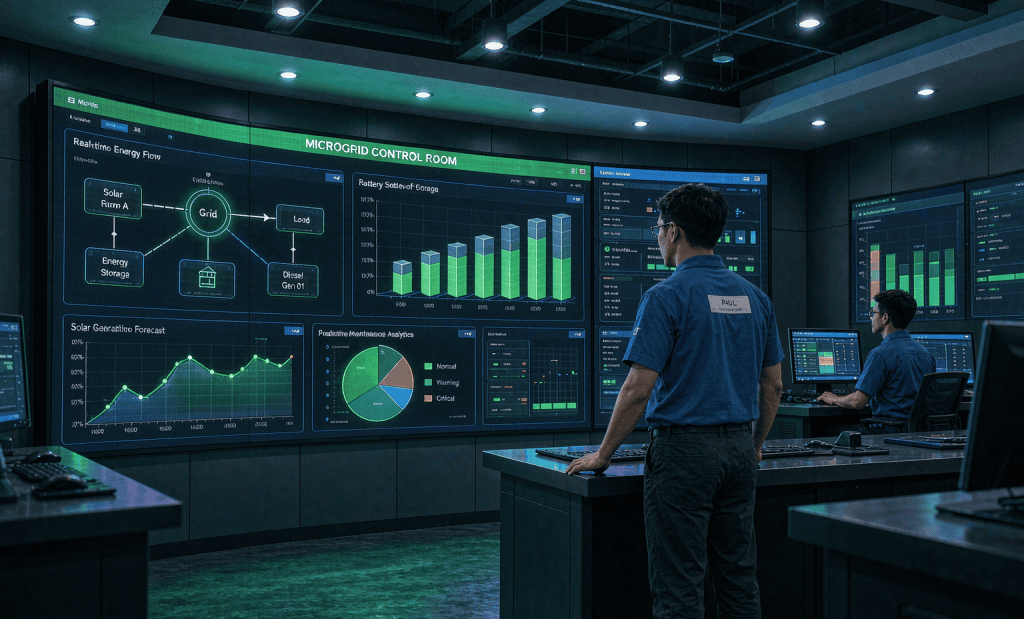
>Modern microgrids are no longer simple “solar plus diesel” setups. As sites combine photovoltaics, battery storage, and backup generators — often in harsh, off-grid environments like Saudi Arabia’s mining and construction sectors — the control problem gets harder. Deciding when to charge, discharge, or start a diesel genset used to rely on fixed rules. In 2027, artificial intelligence is rewriting that playbook. AI-driven energy management systems (EMS) learn from site data, forecast demand, and optimize dispatch in real time. This article breaks down how AI microgrid energy management works in 2027, where it delivers the biggest wins for industrial buyers, and how PORTA’s hybrid systems are built AI-ready from the container up.
>An Energy Management System is the brain of any microgrid. It continuously balances generation, storage, and load. A traditional EMS runs on predetermined rules — “start the diesel if state-of-charge drops below 20%”, for example. That works, but it leaves efficiency on the table. An AI-enhanced EMS goes further: it uses machine learning to recognize patterns in weather, load, and fuel data, then adapts its strategy as conditions change.
>The practical benefits are concrete: higher round-trip efficiency, lower fuel burn, and fewer unplanned outages. Key techniques include neural networks for pattern recognition and reinforcement learning, where the controller is rewarded for keeping costs and emissions low. The table below shows how the two approaches compare across the metrics industrial operators care about. See also our guide on All-in-One EMS & PCS integration.
| Dimension | Rule-Based EMS | AI-Enhanced EMS |
|---|---|---|
| Control logic | Fixed thresholds | Learns from data, adapts |
| Load forecasting | None or static | Weather + schedule aware |
| Dispatch optimization | Manual / scheduled | Real-time, cost-aware |
| Maintenance | Time-based | Predictive, condition-based |
| Fuel savings | Baseline | Typically +10–25% vs rules |
| Operator UI | Alarms only | Dashboards + recommendations |
>Accurate load forecasting is where AI pays for itself first. Algorithms ingest historical consumption, weather forecasts, and operational schedules — a mine site’s haul-cycle plan, a camp’s shift roster — to predict demand hours ahead. That forecast drives two decisions: when to pre-charge the battery from cheap solar, and when to keep the diesel offline entirely.
>Consider a remote Saudi mining camp. Daytime ancillary loads spike with excavation; nights are dominated by HVAC and lighting. An AI model trained on weeks of site data can anticipate the evening ramp and top up the battery beforehand, so the genset never fires during the expensive evening peak. PORTA’s EMS architecture supports exactly this kind of forecasting-driven dispatch.
AI load-forecasting loop: site data (load, weather, schedule) → AI forecast model → demand prediction → smart dispatch decision. Cleaner inputs produce sharper forecasts and lower fuel use.
>For grid-connected or fuel-dependent sites, AI turns the EMS into a cost optimizer. Where time-of-use tariffs exist, the system shifts flexible loads, charges batteries during low-price windows, and discharges to avoid high-price periods. At off-grid sites — PORTA’s core market — the same logic targets fuel: the controller minimizes diesel runtime by stretching battery autonomy and only starting the genset when solar plus storage cannot cover the load.
>Across industrial deployments, that discipline consistently pushes fuel savings past the 60% mark versus a pure-diesel baseline, and toward the 80% ceiling PORTA designs for. Read more in our 6 microgrid & storage trends for 2026.
Fuel-focused dispatch: solar-first → battery peak-shaving → diesel as last resort. AI tightens each hand-off so the genset runs only when it must.
>AI’s second big win is asset health. By streaming sensor data from panels, batteries, and generators, the EMS can flag degradation long before a breakdown. Examples: a solar string underperforming by 8% suggests soiling or a failing module; a battery cell-voltage spread widening indicates imbalance; a genset exhaust-temperature drift hints at looming maintenance.
>Catching these early means maintenance is scheduled, not emergency. For remote sites where a failed component means a multi-day wait for parts, that foresight protects both uptime and budget. PORTA’s mobile BESS and foldable solar containers are designed with the telemetry headroom to support this monitoring.
Predictive-maintenance workflow: sensor telemetry → AI anomaly detection → health score & alert → scheduled maintenance. From raw telemetry to a planned service window.
>PORTA’s Hybrid All-in-One (PV + Storage + Diesel) integrates a 78 kWp PV array, a 128 kWh LFP battery, a 60 kW inverter, and a 75 kVA diesel backup inside a single 20-foot container, deployed in under three hours. Its EMS already executes the core dispatch logic — solar-first, battery peak-shaving, diesel as last resort — and the architecture is built to absorb AI features as they mature: forecasting modules, price-response agents, and anomaly detection can be layered on without re-platforming.
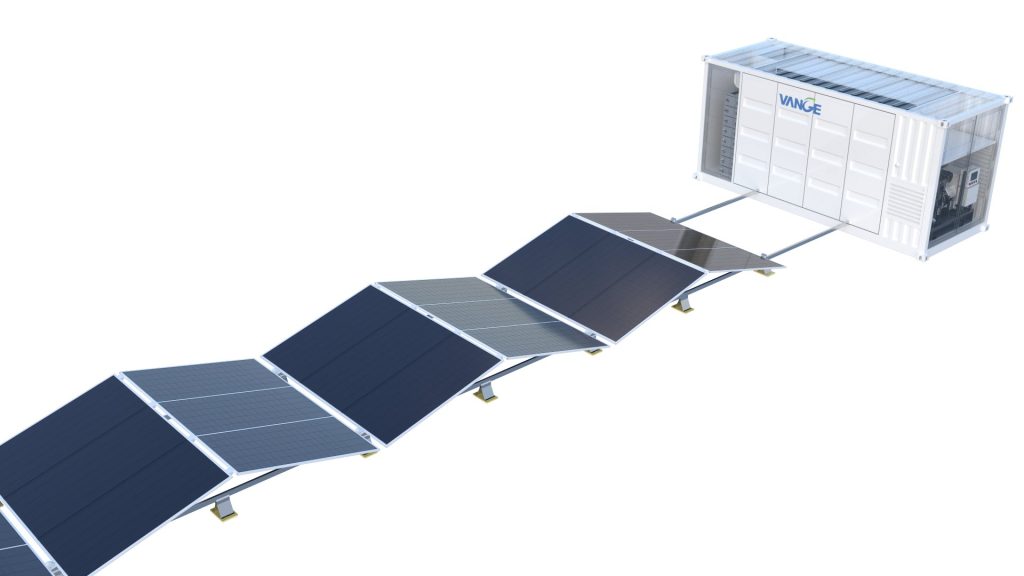
>For operators in Saudi Arabia’s heat and dust, that matters: the system is field-proven, and the upgrade path to AI is software, not hardware.
>The table below expands the comparison across the parameters procurement teams weigh when specifying a controller. The takeaway: AI is an enhancement, not a replacement. Most sites adopt it incrementally — starting with forecasting and predictive maintenance before touching full autonomous dispatch.
| Parameter | Traditional EMS | AI-Enhanced EMS |
|---|---|---|
| Adaptability | Static | Continuous learning |
| Forecasting accuracy | Low | High (weather/schedule) |
| Cost optimization | Rule-based | Dynamic, multi-signal |
| Maintenance | Calendar-based | Predictive |
| Cybersecurity surface | Small | Larger — needs hardening |
| Upfront cost | Lower | Higher (data + models) |
| Best for | Stable, simple loads | Variable, remote, multi-source |
>AI is not a free lunch. Three realities matter for off-grid buyers:
>Practical advice: evaluate AI readiness by auditing your existing telemetry, then phase features in.
>Watch three trends: digital twins that simulate the microgrid before acting; edge AI that runs models on-site without constant connectivity; and energy-trading protocols (including blockchain-based settlement) that let microgrids trade surplus power. PORTA is tracking all three so customers’ systems stay future-proof.

Q: What is AI microgrid energy management?
A: It uses AI algorithms to optimize distributed energy resources — solar, storage, diesel — by predicting demand, responding to price signals, and enabling predictive maintenance.
Q: How does AI improve microgrid efficiency?
A: By analyzing historical and real-time data to decide when to charge/discharge batteries, run generators, and manage loads, reducing waste and lowering operating costs.
Q: Is AI in microgrids expensive to implement?
A: There is an initial investment, but the long-term savings from reduced fuel, lower maintenance, and longer asset life usually outweigh it — especially for large industrial sites.
Q: Can existing microgrids be upgraded with AI?
A: Yes. Many systems can be retrofitted with AI-enabled EMS controllers, though ease depends on the current system's compatibility and data infrastructure.
>AI in microgrid energy management is moving from lab to field in 2027. For off-grid industrial operators, the wins are immediate: smarter forecasting, lower fuel bills, and fewer surprises. PORTA’s AI-ready hybrid systems are built to capture them — start with our free microgrid configurator to size your site, then talk to our engineers about an AI-ready deployment.
Get a customized technical proposal and a capacity-ready quotation. Response within 24 hours.
Email: Jayden@solarstoragediesel.com
WhatsApp: +966 539412006
Riyadh, Saudi Arabia | Nanjing, China
Get a customized technical proposal and pricing for our mobile energy solutions.
Tell us about your requirements and we’ll build a solution.
Ask me anything about solar-storage-diesel hybrid microgrids!