


30-Second Summary: Six shifts are quietly redefining off-grid and weak-grid power in 2026: African mining microgrids prove zero-diesel at industrial scale; remote sites standardise on PV+storage; sodium-ion claims its own technology lane; AI data centres turn BESS into core infrastructure; European virtual power plants scale past gigawatt-hours; and Chinese suppliers move from box-shipping to full offshore integration. Here is what each trend means and why it matters for your next project.
Across the global market for off-grid and weak-grid power, a quiet revolution is happening. African copper mines now run continuous-duty loads entirely on solar-plus-storage. Fishing ports, border crossings, and remote construction camps are replacing noisy diesel skid-mounts with plug-and-play PV-battery containers. Sodium-ion batteries have stopped chasing lithium prices and started claiming their own technology lane. AI data centres are turning battery energy storage into core compute infrastructure, not backup. European virtual power plants are scaling past gigawatt-hours while negative electricity prices become the new normal. And the suppliers who used to ship container-loads of power electronics are now running full BOO projects and gigafactories overseas.
This article maps the six trends that matter most in 2026 — not the hype cycle or the analyst projections, but the shifts already visible in procurement tenders, bankability decisions, and commissioning reports from sites that used to run 24/7 on diesel.
The single most important proof point for the entire off-grid industry happened in 2025 — and most people missed it. A large copper-cobalt operation in the Democratic Republic of Congo commissioned a solar-plus-battery microgrid that now runs continuous-duty process loads — crushing, milling, flotation — entirely on solar and battery storage, with diesel generators relegated to planned maintenance backup.
This was not a small pilot. It was a production-critical power plant serving a mining operation that measures downtime in millions of dollars per day. The system architecture is instructive:
| Parameter | Typical Pre-2024 Mine | 2025-2026 Zero-Diesel Mine |
|---|---|---|
| Solar PV capacity | 5-15 MWp (supplementary) | 30-50+ MWp (primary generation) |
| Battery storage | 2-5 MWh (short buffer) | 50-100+ MWh (full night shift) |
| Diesel role | Primary baseload (24/7) | Planned maintenance backup only |
| Diesel run hours/year | 8,000-8,760 (continuous) | 200-500 (maintenance windows) |
| Diesel fuel cost/year | $15-30M (at $1.50/L delivered) | $0.5-1M |
| CO2 emissions/year | 50,000-100,000 tons | 2,000-5,000 tons |
| Financing model | CAPEX (mine balance sheet) | BOO / PPA (off-balance-sheet) |
What changed between 2024 and 2026 to make this possible?
The second trend is happening at the other end of the scale spectrum: tens of thousands of small-to-medium remote sites that used to depend on 50-500 kVA diesel generator sets are switching to standardised solar-storage containers. These are not bespoke engineering projects — they are off-the-shelf products.
Three sectors are driving adoption:
The common thread: these sites do not need custom engineering. They need a product — a container that arrives on a truck, unfolds in 2-3 hours, and starts saving diesel immediately. The trend is not about technology; it is about productisation. And productisation is what turns a niche into a market.
For two years, sodium-ion (Na-ion) batteries were positioned as the cheaper alternative to LFP. That narrative unravelled in late 2024 when LFP cell prices crashed below $50/kWh — Na-ion could not compete on pure $/kWh for high-volume applications. But in 2025-2026, the technology found its true niche:
| Application | Why Na-Ion Wins | LFP Limitation |
|---|---|---|
| High-temperature operation (50-65°C) | No thermal runaway up to 70°C, no derating needed | Requires active cooling above 45°C ambient, derates 20-30% |
| Deep discharge cycling (0-100% SOC) | Tolerates full discharge without capacity fade acceleration | Calendar life degrades faster when routinely discharged below 10% SOC |
| Cold-climate storage (-30 to -10°C) | Retains 85-90% capacity at -20°C without heating | Capacity drops to 50-60% below -10°C without active heating |
| Ultra-low-cost stationary storage | Abundant raw materials (sodium, carbon), no lithium/cobalt/nickel supply risk | Subject to lithium carbonate price volatility |
| Safety-critical indoor installations | Inherently non-flammable, passes nail penetration test at 100% SOC | Thermal runaway risk requires fire suppression systems |
The key insight for off-grid buyers: Na-ion is not a replacement for LFP — it is the better choice for specific operating conditions that happen to be common in mining, desert telecom, and tropical agriculture. A BESS deployed at a Saudi desert site where ambient temperatures hit 55°C in July is a stronger Na-ion use case than a temperature-controlled data centre in Northern Europe.
By end of 2025, CATL, HiNa, and Natron had shipped over 15 GWh of sodium-ion cells globally. The curve is accelerating: installed Na-ion capacity is projected to triple in 2026 as dedicated gigafactories in China, India, and the Middle East reach volume production.
The AI compute buildout is the largest new load on the global grid since the electrification of air conditioning. A single hyperscale AI training cluster can draw 100-300 MW continuously — comparable to a small city. The question keeping data centre operators awake: where does the power come from?
The answer, increasingly: on-site solar-plus-storage, with the BESS playing a role far beyond backup.
| BESS Function | Traditional Data Centre | AI Data Centre (2025-2026) |
|---|---|---|
| Primary role | UPS backup (15-30 minutes) | Load shifting + peak shaving + frequency regulation |
| Discharge duration | 15-30 minutes (diesel generator bridge) | 2-6 hours (time-shift solar into evening) |
| Capacity (per 100 MW IT load) | 5-10 MWh | 200-600 MWh |
| Integration with solar | None (solar is decorative/PR) | DC-coupled or co-located AC solar farm |
| Revenue stacking | Zero (pure cost centre) | Grid services + demand response + capacity payments |
| Typical diesel run hours/year | 12-24 (monthly testing) | 0-50 (BESS handles all short-duration events) |
The change is being driven by three forces:
Bottom line for the microgrid industry: data centres are no longer just customers for backup power. They are becoming the largest single vertical for multi-megawatt, multi-hour battery storage — and the requirements they impose (sub-ms response, 99.999% availability, stacked revenue streams) are pulling the entire BESS industry upward.
In 2025, Europe’s aggregated virtual power plant (VPP) capacity crossed the 10 GW threshold for the first time. Germany alone added over 600,000 residential battery systems, while utility-scale BESS installations in the UK, Italy, and Spain accelerated. The defining feature of the European market in 2026 is not more batteries — it is the software layer that turns millions of distributed assets into a single dispatchable resource.
Three developments define this trend:
| Development | What Changed in 2025-2026 | Impact on Off-Grid Sector |
|---|---|---|
| Negative electricity prices | Germany recorded 457 hours of negative prices in 2025 (up 52% YoY). Batteries earn revenue by charging during negative-price hours. | Proves the arbitrage business case for storage -- even grid-connected sites can monetise batteries when not using them for backup. |
| Regulatory market access | EU Electricity Market Design reform (adopted 2024, effective 2025) allows aggregated distributed storage to participate in wholesale, balancing, and ancillary service markets on equal footing with large generators. | Creates a revenue stacking template that off-grid microgrids can adapt: solar self-consumption + diesel avoidance + demand response + frequency regulation + capacity payments. |
| VPP platform maturity | Platforms like Sonnen, Tesla Autobidder, and Octopus Kraken now aggregate 500,000+ distributed assets with sub-second dispatch. The technology stack is proven at gigawatt scale. | The same software architecture -- device-level telemetry, cloud-based optimisation, real-time market integration -- is directly applicable to off-grid microgrid fleets. One operator can manage 50 remote sites from a single dashboard. |
For off-grid operators, the European VPP experience is a preview of what becomes possible when batteries are treated as revenue-generating assets rather than cost centres. A remote mining camp in the Saudi desert cannot participate in European balancing markets — but it can apply the same logic internally: use the battery to arbitrage between cheap solar (daytime) and expensive diesel (nighttime), and stack that value with the avoided cost of generator maintenance and fuel logistics.
For the past decade, Chinese microgrid equipment suppliers followed a simple model: manufacture PV panels, inverters, and battery cells in China; ship containers to project sites; and provide remote commissioning support. The model worked for products. It does not work for solutions.
In 2025-2026, the leading suppliers have shifted to a fundamentally different operating model:
| Dimension | Old Model (2018-2024) | New Model (2025-2026) |
|---|---|---|
| Project delivery | Ship equipment, remote support | Local subsidiary with in-country engineering, commissioning, and O&M teams |
| Financing | Buyer pays 100% upfront or L/C | Supplier arranges or participates in project finance (BOO, leasing, deferred payment) |
| Supply chain | All manufacturing in China | Gigafactories in Saudi Arabia, Morocco, India, Indonesia; regional supply chains |
| After-sales | Parts shipped from China (2-8 weeks) | Regional spare parts warehouses, local service engineers, 48-hour response SLA |
| Software/EMS | Basic local controller, no remote access | Cloud-based EMS with AI forecasting, predictive maintenance, fleet management |
| Revenue model | One-time equipment sale | Equipment sale + service contract + energy performance guarantee + data monetisation |
| Risk allocation | All risk on buyer after delivery | Shared risk: supplier guarantees uptime/performance; buyer pays per kWh delivered |
This shift is driven by customer demand. A mining company in Ghana or a telecom operator in Indonesia does not want to become a microgrid operator. They want reliable power at a predictable cost per kWh. The supplier who can offer that — with local presence, local spare parts, and a performance guarantee — wins the contract.
The implications for buyers:
Taken individually, each trend is interesting. Taken together, they reveal a market that is crossing an inflection point:
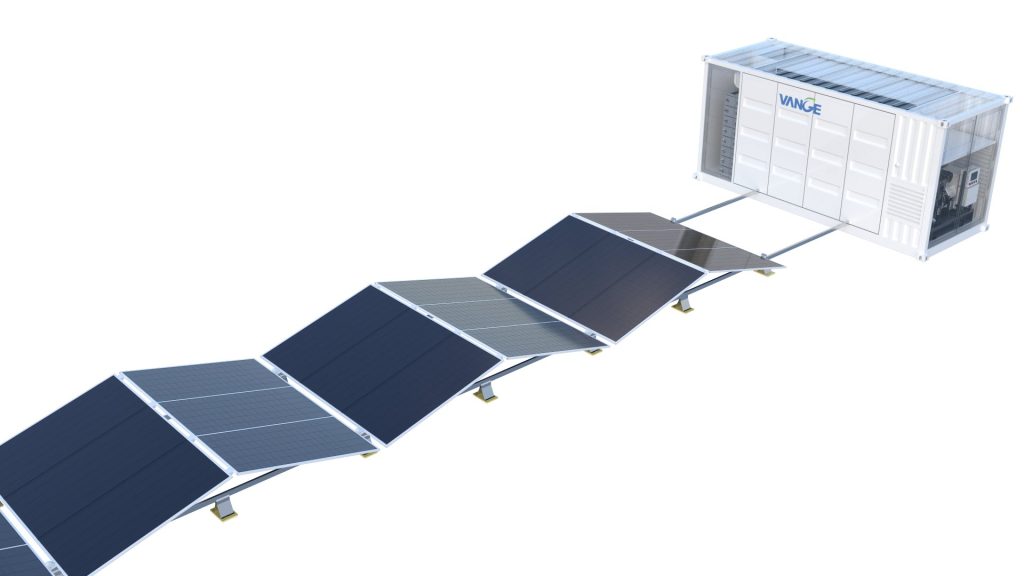
PORTA containerized ALL IN ONE systems are designed for the market conditions described in this article. A single 20ft high-cube container integrates 78 kWp of foldable solar PV (LONGI 650Wp panels), 128 kWh of LFP battery storage, a 60 kW inverter, and a 75 kVA diesel generator. Deploy in 2-3 hours. No civil works. No bespoke engineering.
Scalable configurations are available:
| Model | PV (kWp) | BESS (kWh) | Inverter (kW) | Diesel (kVA) | Target Site |
|---|---|---|---|---|---|
| PBD78-60 | 78 | 129 | 60 | 75 | Remote camp, small mine, fishing port |
| PFCF104+BESS | 104 | 258 | 100 | Optional | Mid-size industrial, construction camp |
| PFCF130+BESS | 130 | 482-723 | 200-250 | Optional | Large mine camp, border post |
| Multi-unit array | 156-260 | 258-966 | 120-300 | 150-300 | Mining operation, data centre |
Every system ships with:
If 2024 was the year the off-grid industry proved that solar-storage-diesel hybrid microgrids work technically, 2025-2026 is the year they proved they work economically — at scale, across sectors, in the most demanding environments on the planet.
The question for off-grid operators is no longer whether to add solar and storage to their diesel generators. The question is whether to add a small diesel generator to their solar and storage system — as insurance, not as the primary energy source.
For mining companies, telecom operators, agricultural processors, and remote infrastructure builders, the six trends mapped in this article converge on a single message: the technology is ready, the economics are compelling, the suppliers have matured — and the cost of waiting is measured in diesel bills that no longer need to be paid.
Share your site details -- load profile, diesel consumption, and solar resource. We will design a custom hybrid microgrid with full ROI analysis within 48 hours.
Email: jayden@solarstoragediesel.com | WhatsApp: +966 539412006 | Riyadh, Saudi Arabia
Get a customized technical proposal and pricing for our mobile energy solutions.
Tell us about your requirements and we’ll build a solution.
Ask me anything about solar-storage-diesel hybrid microgrids!