


TECHNICAL GUIDES / TELECOM
Overview: A field-ready 6-step telecom tower hybrid power sizing framework for Saudi sites: load audit, solar yield, battery chemistry, diesel backup, deployment, and remote monitoring.
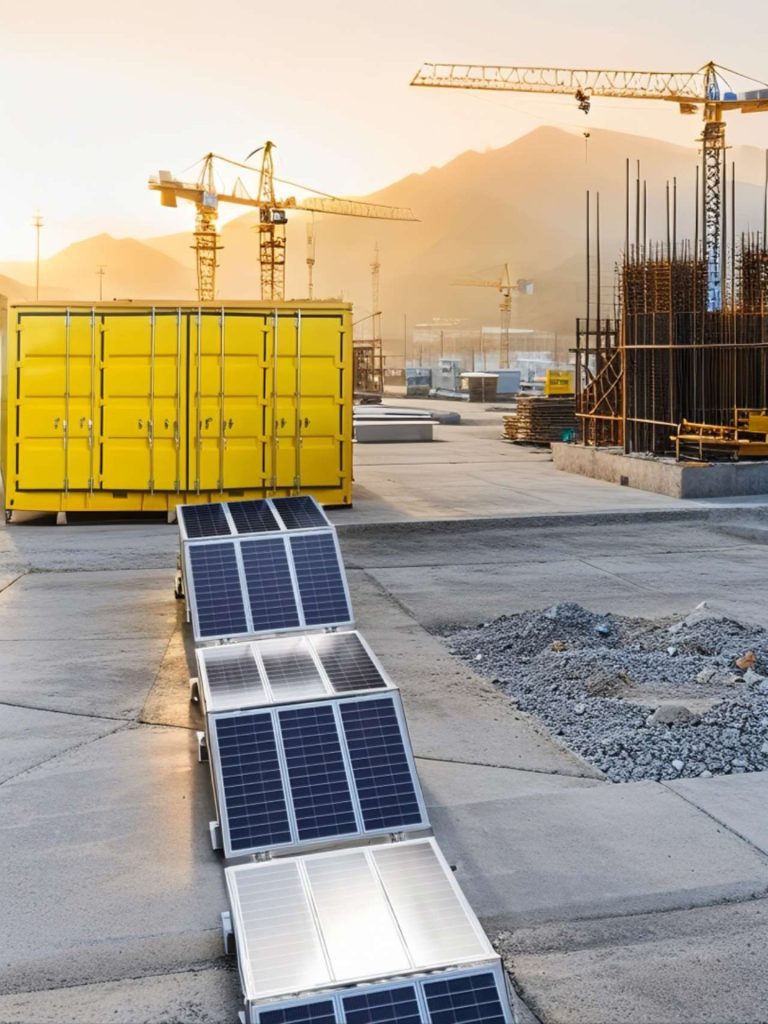
>Telecom tower hybrid power sizing in the Kingdom is a different discipline from sizing a tower in Europe or North America. Saudi sites combine three pressures that quietly break naive designs: unreliable grid at the edge, diesel logistics across long desert distances, and ambient temperatures that regularly exceed 50°C. A sizing framework that ignores any one of them will either strand diesel savings or shorten equipment life.
>Most Saudi telecom sites still lean on diesel generators, with fuel cost swings of 60–80% over a project lifetime. Grid power is patchy in remote governorates, so the hybrid system must be sized for real autonomy — not just “grid-available, sometimes.” And Vision 2030 plus operator ESG targets are pushing hard toward diesel reduction, which means the sizing decision is now a CAPEX-versus-OPEX trade-off with a deadline attached.
>This framework gives operators and engineers a field-ready, six-element method: load audit, solar resource, battery, diesel, site logistics, and monitoring. It connects survey data straight to real hybrid product specs, including PORTA foldable solar containers and mobile BESS. For the operator-side business case, see how all-in-one solar-diesel microgrids cut telecom tower fuel costs by 70% in Saudi Arabia.
>You cannot size a hybrid system against a nameplate. You size it against the *shape* of demand. A typical 4G tower pulls 1.5–3 kW continuous, with peaks up to 5 kW during cooling cycles; a 5G upgrade can add another 2–4 kW. Cooling alone can be 30–50% of total load in a Saudi summer, and the battery-room air conditioner is a hidden parasitic draw.
>Use a power logger for 7–14 days to capture the real duty cycle, then compute average kWh/day and peak kW. Always leave a 20–30% margin for future radio additions — 5G rollouts are the single most common cause of undersized systems.
| Equipment | Continuous load | Duty note | 5G upgrade |
|---|---|---|---|
| BTS / radio | 1.0–2.0 kW | 24/7 | +1.5–2.5 kW |
| Microwave / backhaul | 0.3–0.6 kW | 24/7 | +0.5 kW |
| Cooling (AC) | 0.5–2.0 kW | Summer peak | +0.3 kW |
| Lighting & security | 0.1–0.3 kW | 24/7 | — |
| **Typical 4G total** | **1.5–3.0 kW** | peak ~5 kW | **+2–4 kW** |
>The curve below is representative: a low overnight base with a daytime cooling bump. The hybrid logic keys off this shape, not the nameplate.
>Saudi Arabia is among the best solar markets on earth, with Global Horizontal Irradiance (GHI) of 5.5–6.5 kWh/m²/day. Pull site-specific data from PVGIS or Meteonorm — do not use a national average for a border site.
>Two desert corrections matter: dust soiling and temperature. Modules lose about 0.4%/°C above 25°C cell temperature, and wiring plus inverter losses add up. A realistic overall derate factor is 0.75–0.80. The sizing formula is:
Required PV kWp = (daily load kWh × 1.2) ÷ (peak sun hours × derate factor)
>For a 60 kWh/day load with 5.5 peak-sun hours and a 0.78 derate, you need roughly 16.8 kWp. A single PORTA foldable solar container (single-side deployment with 40 alternating corrugated faces, tilting 20–25°) can be deployed modularly to meet or exceed that, and scales with load growth. PORTA’s mobile BESS and foldable PV platforms let you stage solar and storage independently of the diesel.
| City | Annual GHI (kWh/m²/day) | Summer peak temp | Peak-sun hrs | Eff. derate |
|---|---|---|---|---|
| Riyadh | ~6.0 | 46–50°C | 5.8 | 0.77 |
| Jeddah | ~5.6 | 42–45°C | 5.4 | 0.78 |
| Tabuk | ~5.8 | 40–44°C | 5.6 | 0.79 |
>Battery capacity is driven by autonomy days and depth of discharge (DoD). With a diesel backup present, 1–2 days of autonomy is typical. The usable capacity formula:
Usable battery (kWh) = daily load (kWh) × autonomy days ÷ DoD
>For a 60 kWh/day load at 1.5 days autonomy and 85% DoD, you need about 106 kWh usable. LFP (lithium iron phosphate) is the proven choice: 80–90% DoD, 3,000–5,000 cycles, and good high-temperature behavior with modest cooling. Sodium-ion is emerging — better thermal stability and lower cost per kWh, but lower cycle life and energy density. For 45°C+ ambient, evaluate total cost of ownership, not just the sticker price.
>The flow below shows how autonomy and DoD expand into a pack size — and why a 1-day design risks generator cycling.
>Size the generator for peak load plus battery-charging power — but never oversize it. A good rule is 1.25 × peak load. In hybrid mode the generator runs hard to charge the battery, then shuts off; well-sized systems cut annual runtime by 70–85%.
>Fuel consumption is 0.3–0.4 L/kWh for a diesel set running partial load; a tuned hybrid can drop effective consumption toward 0.1 L/kWh. Remote sites should plan 7–14 days of fuel storage to absorb delivery gaps, and budget for theft-proof tanks. Crucially, avoid low-load running — that is what causes wet stacking and early failure. The all-in-one Saudi tower case study shows the runtime and savings math in the field.
| Peak load | Recommended gen (1.25×) | Charge rate | Notes |
|---|---|---|---|
| 3 kW | 5 kVA | 2–3 kW | Micro tower |
| 5 kW | 8 kVA | 3–4 kW | 4G + cooling |
| 9 kW | 12 kVA | 5–6 kW | 5G ready |
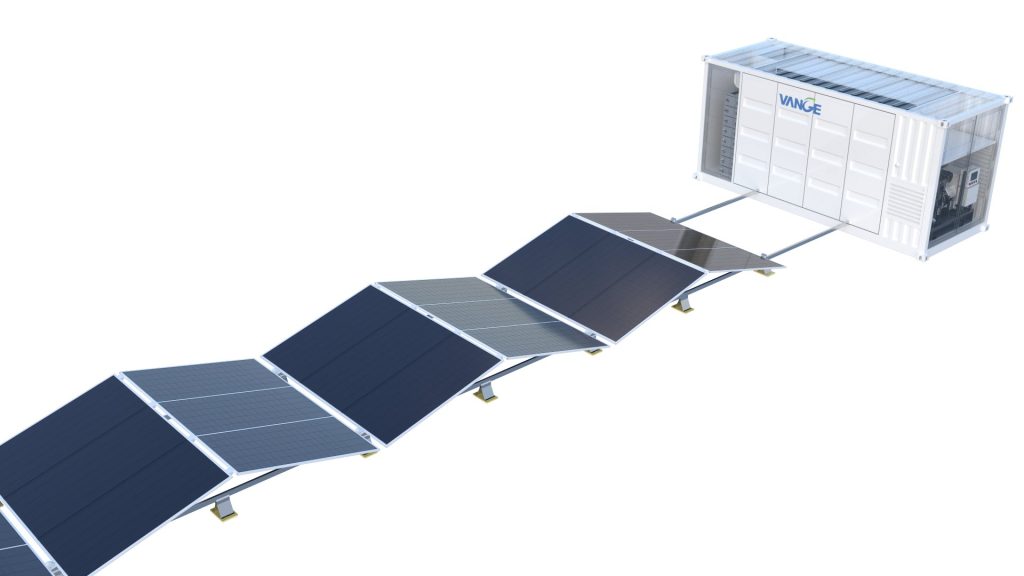
>A tower site is constrained by access, space, and security — and those constraints decide whether you deploy containerized or build fixed. PORTA foldable solar containers deploy in under 3 hours on tracks, with single-side deployment and 40 alternating faces; no roof penetration and minimal footprint. Solar faces tilt 20–25° for optimum yield.
>The product photo below shows a foldable solar container staged for a remote site — the same asset class used at telecom compounds.
>Hybrid savings only hold if you can see them. Remote monitoring tracks solar yield, battery state of charge (SOC), diesel runtime, and load — and turns that data into proactive maintenance. PORTA hybrid ALL-IN-ONE units ship with an EMS that exposes remote access and can feed a network operations centre (NOC).
>Set alarms for battery temperature, generator faults, and low SOC; use the logged data to refine sizing after the first season. The dashboard mock below shows the three panels an operator should never be without.
>Worked example — a 2 kW continuous load, 48 kWh/day, sited near Riyadh:
>Expected diesel reduction: 70–85%; payback 2–4 years depending on fuel price. Five global telecom microgrid cases prove 70–85% diesel savings are real — and Saudi operators can replicate the pattern.
| Parameter | Value |
|---|---|
| Daily load | 48 kWh/day |
| Solar PV | 15 kWp |
| Battery | 80 kWh LFP |
| Diesel backup | 10 kVA |
| Diesel reduction | 70–85% |
>The six steps above turn a site survey into a defensible hybrid design. The fastest way to move from assessment to a sized system is the free solar-diesel-storage microgrid Configurator — enter your load and site, get a configuration in about five minutes. For a site-specific engineering proposal, contact PORTA directly.
>A typical 4G tower draws 1.5–3 kW continuous, with peaks up to 5 kW; 5G can add 2–4 kW. Always measure with a power logger for 7–14 days rather than trusting the nameplate.
>Use usable battery capacity (kWh) = daily load (kWh) × autonomy days ÷ depth of discharge. For 1.5 days autonomy and 85% DoD, multiply your daily load by about 1.76.
>LFP is proven with cooling; sodium-ion is emerging with better thermal stability but lower cycle life. Evaluate total cost of ownership for your specific ambient profile.
>Well-sized hybrid systems typically reduce diesel consumption by 70–85% compared with diesel-only operation.
>Yes. PORTA foldable solar containers are mobile, deploy in under 3 hours, and scale modularly to match your load — ideal for remote tower compounds.
Get a customized technical proposal and a capacity-ready quotation. Response within 24 hours.
Email: Jayden@solarstoragediesel.com
WhatsApp: +966 539412006
Riyadh, Saudi Arabia | Nanjing, China
Get a customized technical proposal and pricing for our mobile energy solutions.
Tell us about your requirements and we’ll build a solution.
Ask me anything about solar-storage-diesel hybrid microgrids!