


30-Second Summary: Five global telecom microgrid deployments across Africa and Asia have consistently cut diesel consumption by 70-85% with solar-diesel hybrid systems. Saudi Arabia's superior solar resource and available development financing make the business case even stronger for PORTA's foldable solar microgrids.
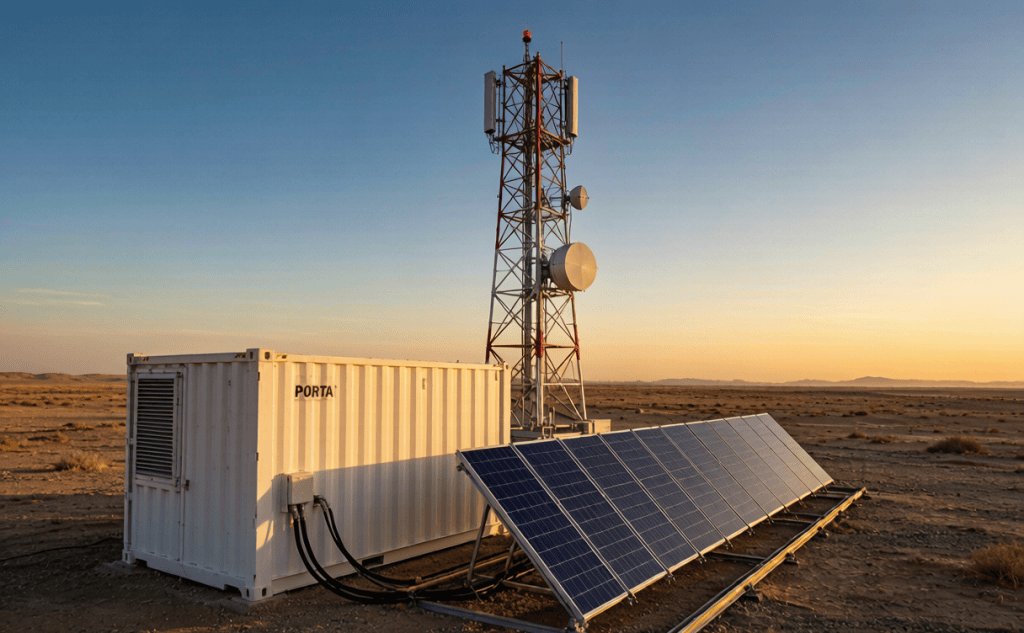
Every year, the world’s telecom operators burn through billions of liters of diesel to power off-grid and unreliable-grid tower sites. In Sub-Saharan Africa alone, the GSMA estimates that over 640,000 telecom towers consume approximately 1.5 billion liters of diesel annually. The financial drain is staggering, the logistics are fragile, and for tower operators managing hundreds or thousands of sites, diesel supply chains represent the single largest operational risk to network uptime.
But the data from real-world deployments now tells a different story. Across Africa, Asia, and the Middle East, solar-diesel hybrid microgrids are cutting telecom tower fuel consumption by 70% to 85%, with payback periods of just 2 to 3 years. These are not pilot projects. They are commercial-scale deployments with multi-year operating histories, documented by GSMA, Ericsson, Clear Blue Technologies, and major tower companies.
This article examines five landmark telecom microgrid case studies — covering Somalia, Tanzania, South Asia, and Pan-African deployments — extracts the common success patterns, and shows how Saudi telecom operators can apply these lessons with PORTA’s foldable solar-diesel microgrid platform to achieve even stronger results in the Kingdom’s unique operating environment.
Somalia’s telecom infrastructure operates under some of the harshest conditions on the planet. Grid power is virtually nonexistent outside major cities. Fuel supply chains are disrupted by conflict, poor roads, and seasonal flooding. Security concerns make site visits expensive and dangerous. Yet mobile connectivity is essential — Somalia has one of the highest mobile money adoption rates in Africa.
A major Somali mobile operator retrofitted 30 off-grid base transceiver station (BTS) sites with solar photovoltaic arrays and battery storage, integrated with existing diesel generators. The per-site investment was approximately USD 42,000.
The system used solar PV as the primary power source during daylight hours, with battery storage covering evening loads and managing cloud transients. The diesel generator, which previously ran 24 hours a day, was relegated to backup duty. This priority dispatch logic — solar → battery → diesel — is the single most important factor in achieving telecom microgrid savings.
Tanzania’s geography presents a different challenge: a mix of grid-connected urban towers where grid reliability is poor, and fully off-grid rural sites where fuel logistics dominate operating costs. The micro base station format — lower-power BTS serving smaller coverage areas — is increasingly common in rural deployments.
A telecom operator deployed a compact solar-diesel-battery hybrid system at a micro BTS in rural Tanzania. The configuration: 5 kWp of solar photovoltaic panels, 20 kWh of lithium battery storage, and an 8 kW diesel generator as backup.
The 78% reduction in levelized cost of energy is the headline figure telecom CFOs need to see. At USD 0.45/kWh, a micro BTS consuming 5,400 kWh per year costs approximately USD 2,430 annually in fuel alone. At USD 0.10/kWh, the same site costs USD 540 per year. The difference compounds rapidly across a portfolio of hundreds of sites.
Clear Blue Technologies, a Canadian smart off-grid power company, has deployed its Nano-Grid solar-battery power packs at over 500 telecom sites across Sub-Saharan Africa. What sets this deployment apart is not just the scale, but the business model.
Pre-integrated solar-battery power packages — combining photovoltaic panels, lithium batteries, and Clear Blue’s Illumience cloud-based remote management platform — were deployed at tower sites across multiple African countries. The system uses predictive analytics to forecast solar generation, battery state of charge, and load demand, optimizing diesel generator dispatch in real time.
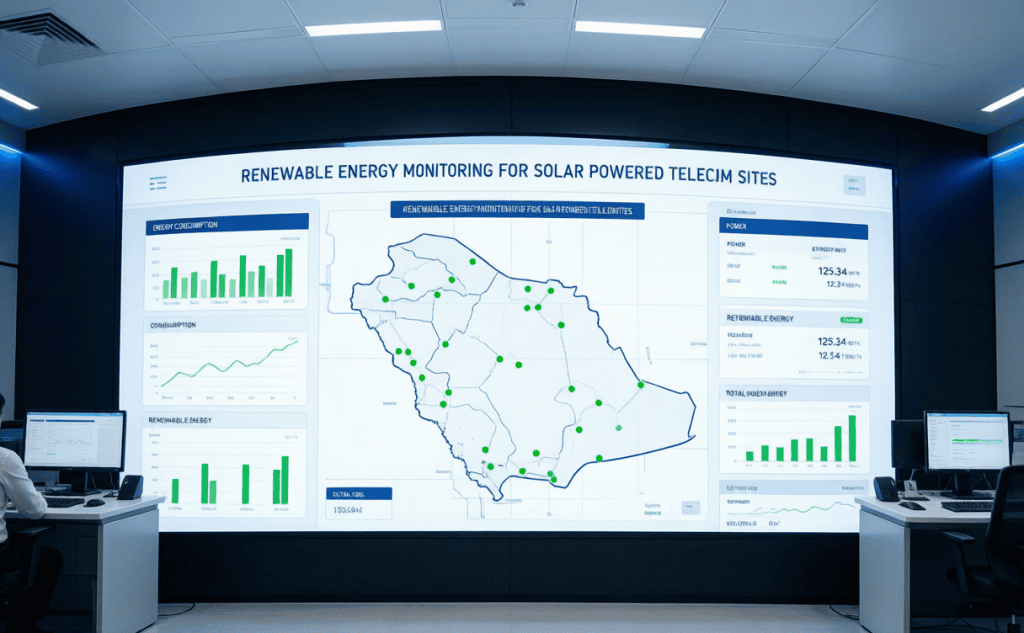
The cloud control advantage is the force multiplier behind these results. By continuously monitoring voltage, current, battery health, and generator status across all 500+ sites, it enables predictive maintenance — identifying failing batteries before they cause outages, scheduling fuel deliveries based on actual consumption, and remotely reconfiguring dispatch logic without sending a truck.
The EaaS model is particularly relevant for Saudi Arabia’s Vision 2030 context. By converting a capital expenditure into an operating expense — paying per kilowatt-hour of reliable power — telecom operators can deploy solar microgrids without balance sheet strain, freeing capital for spectrum licenses and network expansion.
In South Asia’s mountainous regions, telecom towers face steep terrain, seasonal access restrictions, and grid power that ranges from unreliable to nonexistent. A major telecom infrastructure provider deployed standardized 5 kWp photovoltaic kits with 10 kWh lithium iron phosphate battery storage at each tower site.
The design philosophy was radical simplicity: every tower got the same kit. The system used weather-forecast-based predictive control to manage load prioritization and diesel start logic. When the forecast predicted three consecutive sunny days, the controller allowed deeper battery discharge, knowing it would recharge. When monsoons were forecast, it held reserves higher.
For Saudi operators considering microgrid deployment across hundreds of remote sites — particularly along the Red Sea coast, the Empty Quarter periphery, and the northern border regions — the standardization lesson is critical. A single, validated hardware configuration eliminates the engineering analysis bottleneck, reduces procurement complexity, and creates a single training curriculum for installation and maintenance teams.
The GSMA Green Power for Mobile program has documented and promoted a de facto standard configuration for off-grid telecom BTS sites: a 12–15 kW hybrid inverter system with lithium battery storage, integrated with existing diesel generators.
This configuration — deployed across Africa, Asia, and Latin America by multiple operators — represents the most widely replicated telecom microgrid architecture in the world. The core logic is simple and proven: solar panels charge batteries, batteries power the load, and the diesel generator only starts when battery state of charge falls below a defined threshold.
The dispatch sequence — solar first, battery second, diesel last — is the non-negotiable foundation of telecom microgrid economics. Every hour the diesel generator does not run is an hour of fuel saved, maintenance deferred, and carbon avoided. The battery’s role is not just energy storage; it is the buffer that absorbs solar variability, load spikes, and cloud transients.
Looking across all five case studies — from Somalia’s conflict-zone towers to South Asia’s mountain-top sites — five consistent patterns emerge:

Saudi Arabia’s telecom landscape shares key characteristics with the markets where these case studies were proven:
Saudi Arabia’s advantages include better road infrastructure than Somalia or rural Tanzania, a more mature telecom sector with centralized tower company operations, and access to financing through institutions like the Agricultural Development Fund (ADF) and Saudi Industrial Development Fund. These factors should accelerate deployment and shorten payback beyond what the global case studies achieved.
PORTA’s 78 kWp PV+BESS+DG ALL IN ONE Mobile Microgrid Station (Model PBD78-60) directly addresses the five success patterns identified in the global case studies:
| Global Pattern | PORTA Feature | Why It Matters for Saudi Telecom |
|---|---|---|
| 70–85% diesel savings | 78 kWp solar + 128 kWh LFP battery + 60 kW diesel generator, with EMS smart dispatch | Saudi irradiance advantage means even higher savings are achievable — potentially 80–90% at high-DNI sites |
| 2–3 year payback | Containerized, transport-ready design eliminates civil works; deploy in under 3 hours | Faster deployment = faster savings accumulation = shorter payback. No concrete foundations required |
| Remote monitoring | Integrated EMS with remote monitoring and control capability | One NOC operator can manage 50+ sites. Predictive alerts eliminate unnecessary truck rolls |
| Standardization | Single 20-foot container SKU, identical across all deployments | One training curriculum. One spare parts list. One maintenance procedure. Fleet-wide optimization possible |
| Backup security | 60 kW Weichai diesel generator integrated in the same container | Operators keep the backup security they're used to, while slashing its utilization by 80%+ |
PORTA’s patented foldable solar array deploys from a single side of the container along ground-level tracks perpendicular to the container’s long side. When deployed, 120 monocrystalline LONGi panels form 40 alternating wave faces — 20 yang (sun-facing) faces and 20 yin (complementary) faces — each tilted at 20–25° from horizontal in opposite directions. Every face carries 3 panels mounted side-by-side along their long edges, with the folding axes parallel to the panel long edges.
This wave geometry flattens the daily generation curve: in the morning the yang faces catch the low-angle sun; at solar noon both sets of faces generate simultaneously; in the afternoon the yin faces become the primary generators. The result is a wider daily generation window, reducing the battery capacity needed to cover evening loads and further improving the economic case. When not deployed, the entire array retracts into the container and ships as a standard 20-foot ISO unit.
To ground the global case study data in Saudi reality, here is a representative ROI calculation for a Saudi telecom operator with 20 remote off-grid tower sites:
Annual savings: SAR 2,034,760 (84% reduction). Capital investment for 20 PORTA units at SAR 500,000 average is SAR 10,000,000, plus SAR 100,000 for installation — total CAPEX SAR 10,100,000. This yields a simple payback period of approximately 5 years before financing benefits.
Two factors significantly improve the real-world economics. First, ADF and SIDF financing can cover 50–70% of CAPEX with below-market interest rates, reducing the operator’s equity requirement and accelerating net savings. Second, non-fuel benefits — reduced outage penalties, lower security costs, extended generator lifespan, and carbon credit eligibility — add substantial value not captured in the baseline calculation. When these factors are included, the effective payback typically falls to 3–4 years.
Based on the global case study patterns, here is a practical phased approach:
| Risk | Mitigation Strategy |
|---|---|
| Dust and soiling on solar panels | Automated cleaning schedules; anti-soiling coating; tilt angle optimizes self-cleaning |
| Battery degradation in extreme heat | Active thermal management in container; LFP chemistry; battery compartment is shaded |
| Over-promising diesel savings | Use conservative 80% savings target; under-promise and over-deliver |
| Technician skill gap | Standardized design minimizes troubleshooting; comprehensive training; remote engineering support |
| Financing and procurement delays | Begin ADF/SIDF discussions during pilot; prepare standardized business case template |
Five deployments. Three continents. Thousands of tower sites. The verdict is unambiguous: solar-diesel hybrid microgrids cut telecom tower fuel consumption by 70–85%, deliver payback in 2–4 years depending on local diesel economics, improve network uptime, and slash maintenance costs. This is not a technology experiment — it is a proven, bankable operational transformation.
For Saudi telecom operators, the case is even stronger. The Kingdom’s world-class solar resource, Vision 2030 regulatory alignment, available development financing, and PORTA’s containerized, foldable microgrid platform create a faster path to deployment and payback than any of the global case studies enjoyed.
The operators who act now — who deploy pilots, gather their own data, and build internal deployment capability — will lock in a structural OPEX advantage that competitors cannot easily replicate. Those who wait will find themselves paying diesel bills that their peers have already eliminated.
Ready to see what solar-diesel hybrid power can do for your tower network? Contact PORTA’s engineering team for a customized technical proposal, including a site-specific savings analysis and deployment plan.
Tell us your load profile. We will size the right PV + BESS + DG microgrid and return a detailed savings estimate within 24 hours.
Request Your Free AssessmentDisclaimer: Case study data is sourced from publicly available GSMA reports, vendor documentation, and industry publications. ROI calculations are illustrative and should be validated against site-specific load data, diesel logistics costs, and financing terms.
Get a customized technical proposal and pricing for our mobile energy solutions.
Tell us about your requirements and we’ll build a solution.