


At a Glance: Wet stacking is the silent killer of diesel generators on remote sites — unburned fuel builds up in the exhaust and cylinders whenever a genset idles below 30–40% of its rating. This guide explains the engineering mechanism, why load banks are only a stopgap, and how a hybrid microgrid with BESS prevents the problem at its root. Includes a real-world Saudi telecom case study and a free configurator that sizes your hybrid system in minutes.
Every remote site manager knows the black smoke and the rising fuel bill, but few connect them to one underlying failure: diesel generator wet stacking. A generator forced to run far below its rated capacity slowly destroys itself — carbon glazes the cylinders, fuel dilutes the oil, and the machine that was bought for reliability becomes the site’s biggest downtime risk.
This guide covers what wet stacking is, why it happens, and — most importantly — how to prevent it. The best solution is not another cleaning ritual; it is a hybrid microgrid that keeps the generator in its efficient operating band automatically. We explain the engineering, walk through a Saudi case study, and show how to size a system with the free PORTA Microgrid Configurator.
Diesel generator wet stacking is the accumulation of unburned fuel in the exhaust system, cylinders, and turbocharger when a generator runs below roughly 30–40% of its rated capacity for extended periods. At such low loads, combustion temperatures drop, injectors spray fuel that never fully ignites, and unburned diesel condenses onto exhaust and cylinder surfaces — “wetting” the stack with carbon-rich sludge.
The engineering mechanism is straightforward: diesel engines are designed to operate in a load band where cylinder temperatures are high enough for complete combustion. Below that band, the fuel-to-air ratio runs rich, combustion is partial, and carbon builds up on valves, piston crowns, and exhaust pipes. Over time the deposits harden into glaze that fouls injectors, sticks rings, and chokes the exhaust path.
Remote sites — mining camps, telecom towers, drilling pads — are prime candidates because their generators are frequently oversized for the actual load. A 100 kW genset serving a 15 kW average load, running 24/7 “for reliability,” is quietly destroying itself. This is precisely the failure mode a hybrid microgrid is built to prevent. For a broader look at how diesel and storage work together to cut fuel and protect assets, see our guide on hybrid diesel generator operating modes and fuel savings.
Wet stacking is not cosmetic — the consequences compound quickly:
| Performance Metric | Normal Operation | Wet Stacking |
|---|---|---|
| Load factor | 60–80% of rated | Below 30% |
| Exhaust temperature | 350–450°C | Below 250°C |
| Fuel consumption | Rated specific consumption | +10–20% |
| Exhaust smoke | Light / grey at load | Black, sooty at idle |
| Oil condition | Clean, normal level | Diluted, rising level |
| Maintenance interval | 500–1,000 h | Shrinks 30–50% |
The classic answer to wet stacking is a load bank — a resistive load applied periodically to force the generator to burn off carbon deposits. Load banks work, but only as a periodic cleaning ritual, not a continuous solution:
For a remote camp that cannot send a technician out every two weeks, load banks are a stopgap. The comparison below shows why operators increasingly choose a structural fix:
| Factor | Load Bank Approach | Hybrid Microgrid (DG + BESS) |
|---|---|---|
| Frequency of intervention | Every 100–500 h (manual) | Continuous (automated) |
| Fuel impact | Burns extra fuel | Cuts fuel 20–40% |
| Root cause addressed | No | Yes — keeps load in optimal band |
| Remote-site practicality | Low (requires staff) | High (autonomous control) |
| Asset protection | Partial (after damage) | Preventive (before damage) |
A hybrid microgrid prevents wet stacking by solving the underlying problem: the generator no longer has to track a wildly fluctuating load on its own. With a battery energy storage system (BESS) in the circuit, the controller — not the load — decides how hard the genset works:
The result is a generator that runs fewer hours, at higher load, with cleaner combustion — the exact opposite of the conditions that cause wet stacking. An EMS dashboard makes the strategy visible in real time, showing genset dispatch, battery state of charge, and load balance across the microgrid.
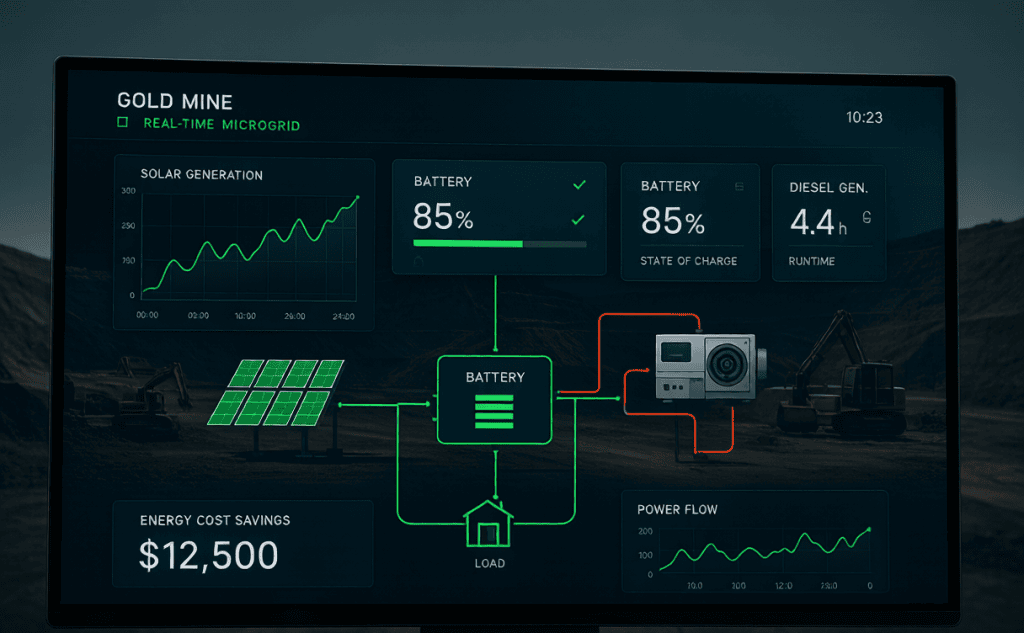
For a deeper comparison of the two main hybrid upgrade paths — pairing batteries with your existing diesel plant versus integrating solar as well — read our analysis of DG+BESS vs. PV+BESS architectures.
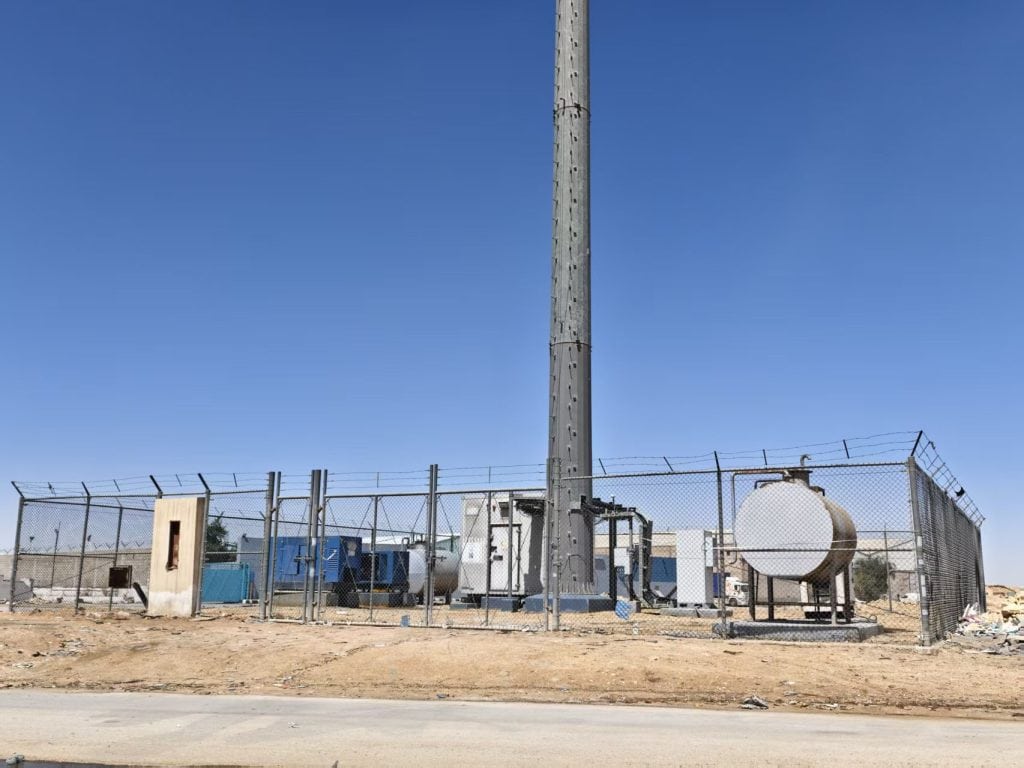
Site profile: a remote telecom tower in Saudi Arabia with a 100 kW diesel generator serving an average load of just 15 kW — a 15% load factor in textbook wet stacking conditions. The genset ran 24/7, oil changes were needed every 250 hours, and black exhaust smoke was a daily sight.
Solution: PORTA’s Hybrid ALL IN ONE (solar + storage + diesel in one container) was integrated at the site. The EMS was configured for load following with peak shaving: the BESS absorbs the site load during light periods, and the genset now runs in short, efficient charging windows instead of idling around the clock.
Results after 12 months:
| Metric | Before | After |
|---|---|---|
| Average genset load factor | 15% | 60% |
| Genset running hours / day | 24 | 9 |
| Fuel consumption | Baseline | −25% |
| Wet stacking incidents | Recurring | 0 in 12 months |
| Oil change interval | 250 h | 750 h |
| Unplanned downtime | 3 events/yr | 0 |
The same pattern applies to mining camps and construction sites: whenever a genset is oversized for its real load, a hybrid retrofit both saves fuel and protects the engine. For sites dominated by pumps and motor loads, see our engineering guide on solar-storage-diesel microgrids for motor loads.
Preventing wet stacking starts at the design stage. Three sizing and control decisions matter most:
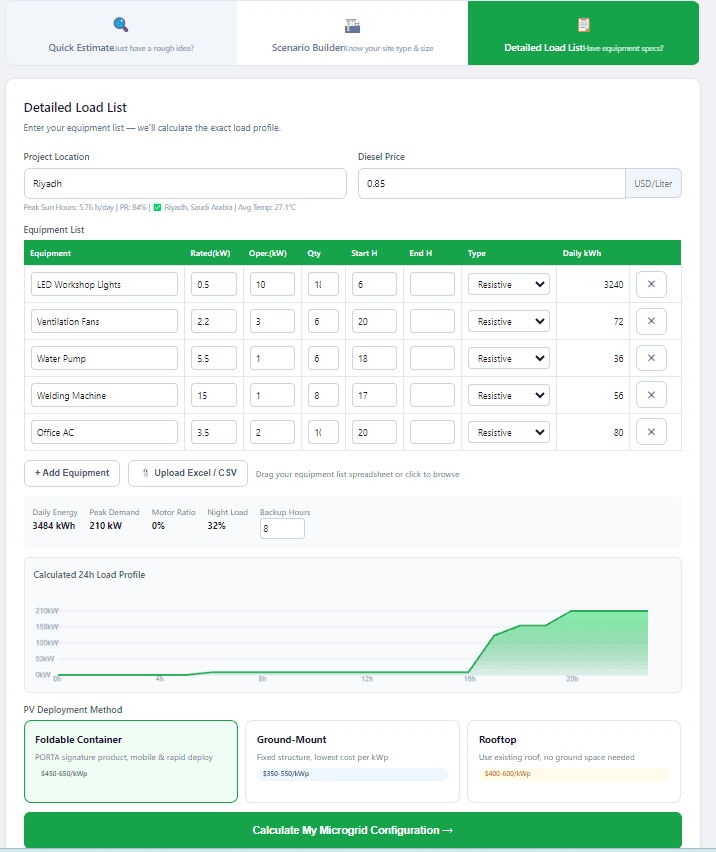
PORTA’s free Microgrid Configurator automates this sizing process. You enter your site’s load profile — the Detailed Load List mode builds a 24-hour curve from your equipment inventory — and the tool returns the optimal genset/BESS/PV mix, plus a 10-year cost forecast. This removes the guesswork that leads to oversized gensets in the first place.
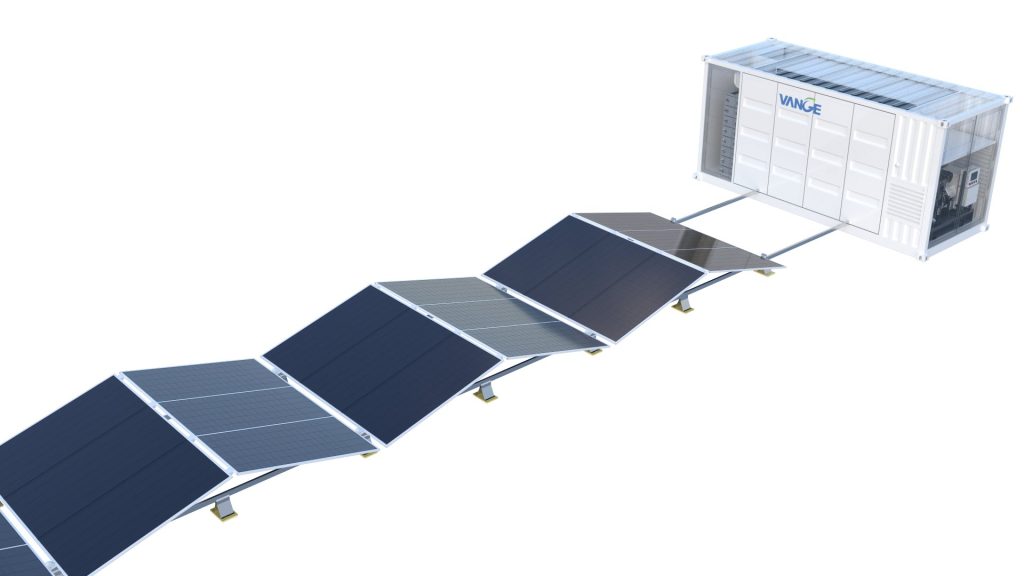
PORTA’s Hybrid ALL IN ONE integrates solar, battery storage, and diesel generation in a single containerized unit, delivered with the EMS pre-configured for wet stacking prevention:
By combining renewable generation with smart diesel dispatch, the ALL IN ONE keeps every asset in its optimal operating band — which is, by definition, a wet stacking prevention strategy.
A load profile audit is the single highest-value step: most operators discover their generator has been oversized for years. From there, the configurator turns the audit into a concrete hybrid system design in minutes.
| Step | Action | Tool |
|---|---|---|
| 1 | Audit your load profile to identify low-load periods | Load logger / site survey |
| 2 | Compare genset rating vs. actual demand | Load profile analysis |
| 3 | Design a hybrid system that optimizes genset loading | PORTA Microgrid Configurator |
| 4 | Configure EMS setpoints (load following, peak shaving) | EMS commissioning |
| 5 | Monitor genset performance and adjust setpoints | EMS dashboard + service log |
Wet stacking is the accumulation of unburned fuel in the exhaust and cylinders when a diesel generator runs under low load for extended periods.
Ensure the generator operates at 30–40% load or higher, use load banks for periodic cleaning, or — preferably — integrate a hybrid microgrid with BESS that keeps the generator in its optimal load band automatically.
Yes. A hybrid microgrid with BESS manages load fluctuations to keep the generator in its optimal operating range, effectively preventing wet stacking rather than merely cleaning up after it.
Costs vary with site requirements and load profile. Use PORTA’s free Microgrid Configurator to get a tailored sizing and cost estimate in about five minutes.
Wet stacking is not an inevitable cost of diesel generation — it is a symptom of a sizing and control problem, and it is preventable. Load banks clean the damage; hybrid microgrids prevent it. By keeping generators in their efficient load band with BESS and smart control, operators cut fuel, extend equipment life, and eliminate unplanned downtime.
Ready to eliminate wet stacking and cut fuel costs?
Use PORTA's free Microgrid Configurator to design your optimized hybrid power system today.
Launch the Free ConfiguratorContact PORTA today to see how our hybrid solutions can keep your gensets running efficiently — or start with the free Microgrid Configurator for a tailored sizing in about five minutes.
Get a customized technical proposal and pricing for our mobile energy solutions.
Tell us about your requirements and we’ll build a solution.
Ask me anything about solar-storage-diesel hybrid microgrids!