

30-Second Summary: Remote oil pump jacks burn diesel 24/7 at crippling costs. A Solar-Storage-Diesel Hybrid Microgrid cuts fuel consumption by 40–60%, extends generator lifespan by 3×, and delivers uninterrupted 24/7 power—even in the harshest desert conditions. Typical payback: 2–3 years.
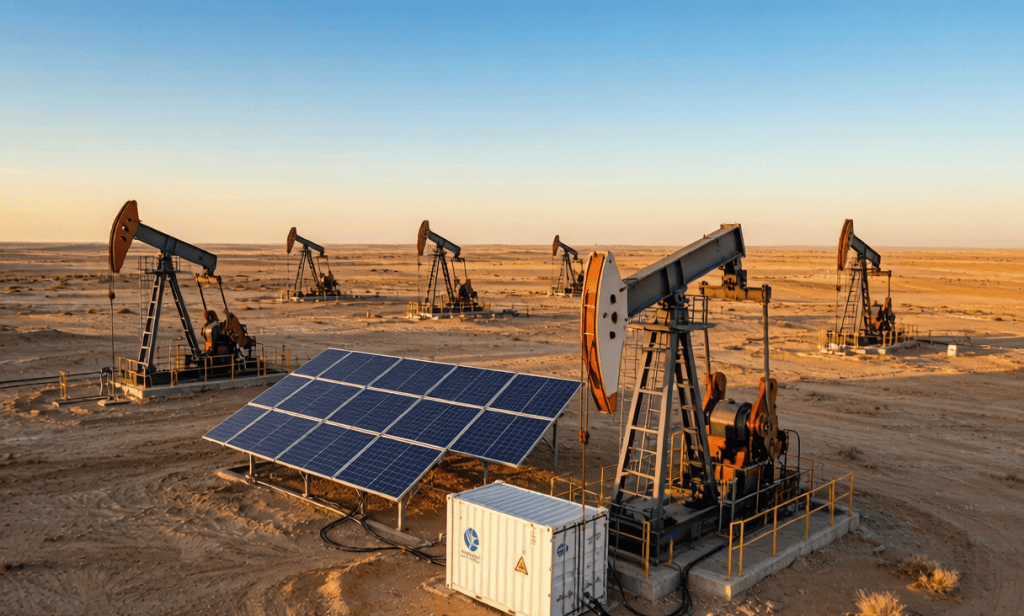
Across the vast desert expanses of Saudi Arabia, thousands of pump jacks—those iconic “nodding donkeys”—rise and fall in steady rhythm, extracting the crude that powers the Kingdom’s economy. But beneath that rhythmic motion lies a hidden cost that quietly drains millions from oil field operators every year: diesel fuel.
For remote well sites far from the national grid, diesel generators are the default power source. They run 24 hours a day, 7 days a week, burning fuel that must be trucked across hundreds of kilometers of desert. When you add up the fuel cost, transportation logistics, maintenance burden, and generator replacement cycles, the Levelized Cost of Electricity (LCOE) from pure diesel generation can reach the equivalent of 3 RMB/kWh—roughly 1.55 SAR/kWh. That is five to six times what grid-connected industries pay.
The question is no longer whether to transition away from diesel-only power. The question is how fast you can deploy a better solution.
If you operate remote pump jacks, you already know the pain points. But let us quantify them:
There is also a fourth, less obvious cost: power quality. Pump jacks create intermittent, high-impact load surges every stroke cycle. Diesel generators struggle to absorb these surges, leading to voltage dips, frequency drift, and—worst case—motor stall and equipment damage.
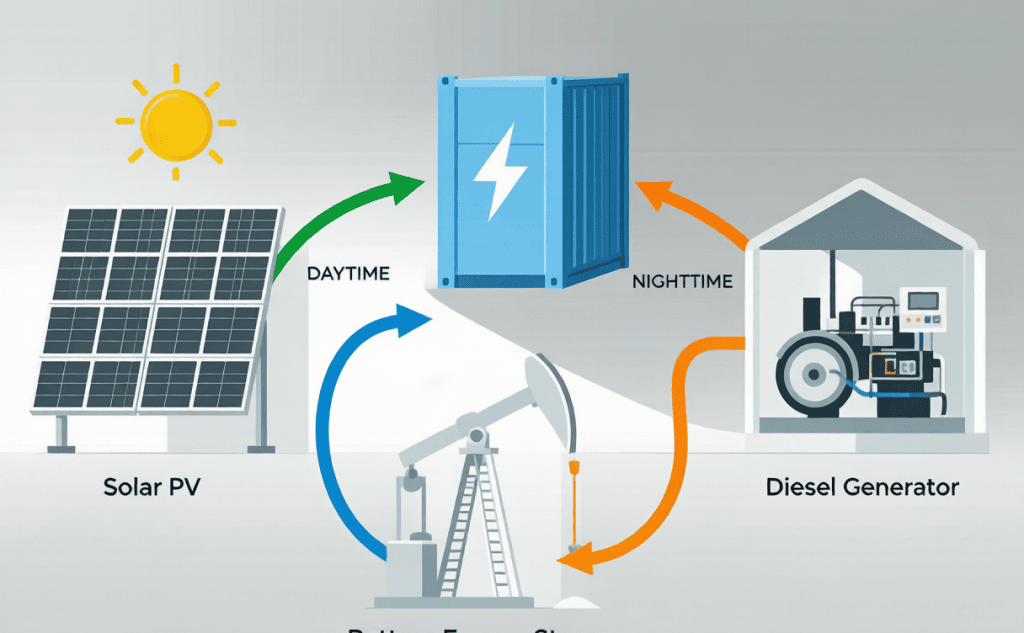
A Solar-Storage-Diesel Hybrid Microgrid does not eliminate your diesel generator. It makes it smarter. The system integrates three power sources—solar PV, battery energy storage (BESS), and your existing diesel genset—into one intelligent microgrid managed by an Energy Management System (EMS).
Here is how the three modes work together:
A large oil field operator in a remote desert region faced exactly these challenges. Their well site had 4 diesel generators powering 12+ pump jacks and a small workers’ camp. Daily diesel consumption was staggering, and generator maintenance was a constant headache.
The solution deployed:
Results after 12 months of operation:
The diesel generators went from being the primary power source to occasional backup. Annual fuel savings exceeded one million RMB (approximately 520,000 SAR). Maintenance costs plummeted as generator runtime dropped by over 60%. And—critically—zero production downtime was recorded due to power interruptions.
In a separate Saudi-based project documented by King Fahd University of Petroleum and Minerals (KFUPM) and presented at the 2025 Middle East Oil & Gas Show, a solar-diesel hybrid system was deployed at a land rig site. The system included:
Documented annual results:
This project validated the scalability of hybrid systems across other rigs and well sites throughout the Kingdom.
Not all hybrid systems are created equal. The extreme conditions of Saudi oil fields—temperatures exceeding 50°C, pervasive sand and dust, and remote locations far from any service center—demand purpose-built equipment.
Our mobile energy solutions are engineered specifically for these challenges:
Pre-wired, rapidly deployable PV systems. Set up in under 1 hour. No civil work required. Pack up and move when a well is depleted.
Containerized battery storage with liquid cooling. Cell temp differential ≤2°C in extreme heat. Fully sealed against dust.
Solar + Storage + Diesel Generator in a single container. Complete power independence for the most remote sites.
AI-powered load forecasting and dispatch. Learns your pump jack duty cycle and optimizes for maximum fuel savings.
Let us break down the economics for a typical remote well site running a 100 kVA diesel generator 24/7:
Extended Generator Life: By cutting generator runtime from 24 hours/day to 8–10 hours/day, you triple the effective lifespan of your genset. That is two fewer generator replacements over a 10-year period—capital savings that go straight to the bottom line.
Reduced Logistics: With diesel consumption cut by half or more, fuel convoy frequency drops proportionally. Fewer trucks on desert roads means lower vehicle maintenance, reduced labor costs, and decreased supply disruption risk.
There is a beautiful irony in using solar energy to pump oil. But it is more than symbolism—it is strategy. Saudi Vision 2030 and the Saudi Green Initiative call for reducing domestic oil consumption and accelerating renewable energy adoption. By deploying hybrid microgrids at remote well sites, oil operators can:
The Middle East energy storage market recorded a staggering 33.95 GWh in overseas project partnerships in just the first five months of 2025. The shift is already happening. The question is whether your operation will lead or follow.
We offer specialized “Oil Field Energy Audits” to calculate your exact SAR savings based on your pump jack power profile, current diesel consumption, and site solar irradiance data.
Every liter of diesel you burn at a remote pump jack is a liter you could be selling at global market prices. A Solar-Storage-Diesel Hybrid Microgrid turns your biggest operational cost—fuel—into a controllable, predictable, and dramatically lower line item. You focus on production and recovery rates; let PORTA handle the kilowatts.
The technology is proven. The economics work. The timing is right. Stop burning profits—start saving them.
Q: What happens to the pump jack if solar power stops suddenly?
Our hybrid microgrid provides triple-layer redundancy. If solar output drops (clouds, sandstorm, nightfall), the battery system takes over in under 20 milliseconds. If the battery is depleted, the diesel generator auto-starts. The pump jack never stops—there is zero interruption to production.
Q: How much diesel can I actually save?
Based on real-world deployments, fuel savings range from 40% to 78% depending on solar resource, battery capacity, and load profile. Well sites in Saudi Arabia's high-irradiance zones typically see savings at the higher end of this range. A site-specific energy audit will give you a precise figure.
Q: Can I move the system when a well is depleted?
Yes. That is exactly what our Foldable Solar Containers are designed for. The entire system—PV array, battery storage, and EMS—packs into standard containers and can be redeployed to a new well site in under a day. No civil work, no permanent infrastructure, no sunk costs.
Q: Is this eligible for Saudi government financing support?
Hybrid energy systems for oil field applications typically qualify under Saudi Vision 2030 sustainability initiatives and may be eligible for favorable financing through programs supporting energy efficiency in the industrial sector. We can assist with documentation and compliance during the audit phase.
Get a customized technical proposal and pricing for our mobile energy solutions.
Tell us about your requirements and we’ll build a solution.