


TECHNICAL GUIDES / CONSTRUCTION
Overview: A practical 7-step checklist to specify a hybrid microgrid for remote construction: load audit, peak/base profiles, diesel baseline, solar-storage sizing, container vs fixed, grid switching, and O&M.
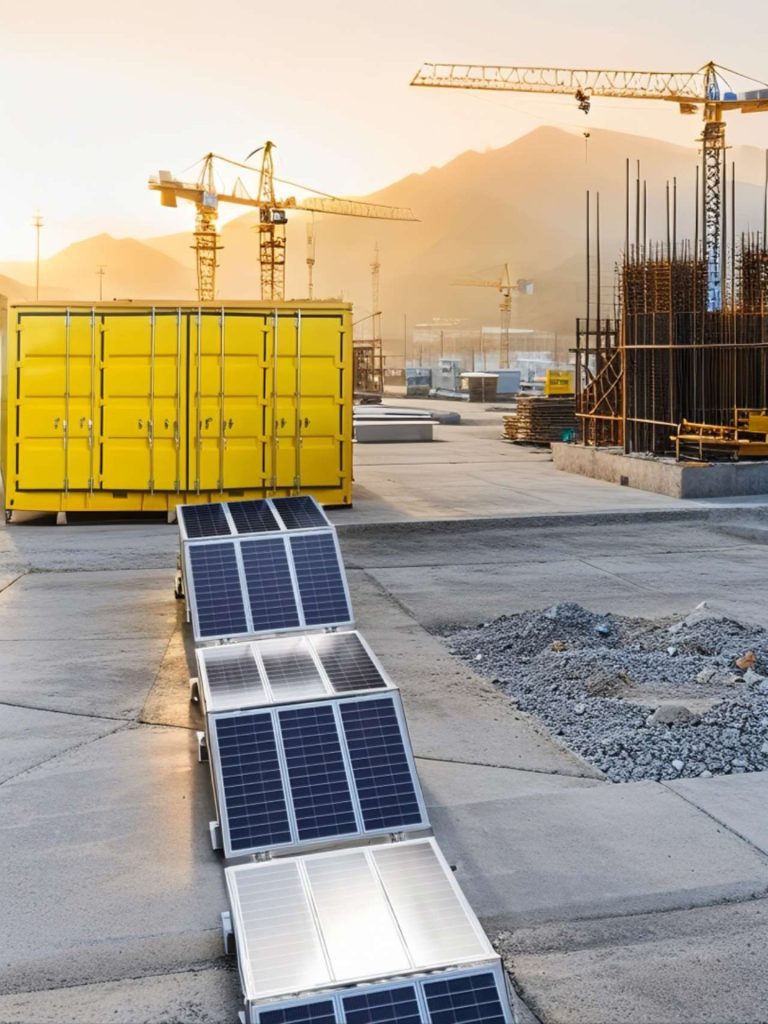
>A reliable building site power supply is the silent prerequisite behind every successful remote construction project. From concrete batching plants in Riyadh’s industrial belts to pipeline camps in the Empty Quarter, sites that sit far from a stable grid depend on power that simply cannot fail. In Saudi Arabia, the challenge is intensified by extreme heat, airborne dust, and logistics distances that make fuel delivery slow and expensive.

>Diesel generators have been the default answer for decades. But diesel-only power is quietly inefficient, and on a multi-month build it quietly expensive. A hybrid microgrid — combining solar, battery storage, and a diesel backup — turns that equation around. This guide gives you a practical, numbers-first checklist to specify one correctly the first time.
>A diesel generator sized for the site’s peak load spends most of its life running at partial load, where specific fuel consumption is at its worst. Beyond the fuel itself, you pay for:
>On a 12-month build, those hidden costs routinely exceed the generator’s capital price.
>A hybrid microgrid lets each source do what it does best. The EMS prioritizes solar during the day, uses the battery for peak shaving and night load, and auto-starts the diesel only during extreme deficits. The result:
>For a turnkey view of how containerized systems solve this, see our breakdown of containerized solar as the turnkey power solution for remote construction and mining sites.
>Before you size anything, you must know what you are powering. A load inventory is the foundation of the entire design, and skipping it is the #1 cause of oversized or undersized systems.
>List every electrical consumer on site: tower cranes, welders, concrete mixers, dewatering pumps, offices, lighting, telecom, and security. For each, record:
>Sum the connected load, then apply a diversity factor (not every load runs at once). The table below is a realistic starting point for a mid-size remote build.
| Equipment | Connected kW | Duty cycle | Starting surge | Critical? |
|---|---|---|---|---|
| Tower crane | 90 | Intermittent | 3.5× | Yes |
| Welding set (×2) | 30 | Intermittent | 2× | Yes |
| Dewatering pump | 15 | Continuous | 4× | Yes |
| Site office & lighting | 12 | Continuous | 1.2× | No |
| Telecom & security | 3 | Continuous | 1.5× | Yes |
| Concrete mixer | 45 | Intermittent | 3× | No |
| **Total connected** | **195** | — | — | — |
>A real tower-crane fuel case study from Dubai shows how targeted hybridization cut crane-related diesel by roughly 30% — read how to cut tower crane fuel costs by 30% in Dubai.
>Connected load is not the same as the load the system must serve. What matters is the shape of demand over a 24-hour day and across project phases.
>Build the curve from your inventory and a typical shift pattern. The profile below is representative of a remote build with a daytime work peak and a small overnight base.
| Time block | Load type | Approx. load (kW) |
|---|---|---|
| 00:00–06:00 | Base (security, pumps) | 30 |
| 06:00–08:00 | Ramp-up | 70 |
| 08:00–12:00 | Day peak (crane, weld, mix) | 160 |
| 12:00–13:00 | Lunch dip | 60 |
| 13:00–17:00 | Day peak | 150 |
| 17:00–20:00 | Wind-down | 70 |
| 20:00–24:00 | Base | 35 |
>Two lessons fall straight out of the curve: the diesel generator should be sized for the base-plus-modest-peak, not the absolute maximum, and the battery should be sized to shave the daily peaks so the generator never lugs along at 20% load.
>You cannot claim savings you cannot measure. Before adding solar and storage, calculate the diesel baseline your current or planned generator would consume.
>Use the load factor, not the nameplate. A 500 kVA generator (≈400 kW) running at 40% average load burns far more per kWh than at 80%. As a worked example:
| Parameter | Value |
|---|---|
| Generator size | 500 kVA (≈400 kW) |
| Average load factor | 40% (≈160 kW) |
| Specific fuel consumption @ 40% | ~0.28 L/kWh |
| Daily energy | 160 kW × 24 h = 3,840 kWh |
| Daily diesel | 3,840 × 0.28 ≈ 1,075 L |
| Annual diesel | ≈ 392,000 L |
>Now add fuel delivery, storage, and maintenance. That annual figure is your baseline — and the number every hybrid proposal should beat. If you are weighing whether a generator is even the right anchor, our guide to the top 5 alternatives to a 500kVA diesel generator lays out the trade-offs.
>This is where the building site power supply becomes a hybrid. Two numbers drive the mix: local solar yield and the load shape from Step 2.
>In Saudi Arabia, most sites see 5.5–6.5 kWh/m²/day of irradiance — among the best in the world. Size solar to cover daytime loads and charge the battery; size storage to carry the night base load and shave daytime peaks so the generator runs fewer, fuller hours.
>For a deployable, scalable starting point, PORTA’s foldable solar container delivers 78 kWp from a single standard unit (single-side deployment with 40 alternating corrugated faces, tilting 20–25°), and mobile BESS units add storage in 55–723 kWh blocks. A compact all-in-one hybrid (78 kWp PV + ~128 kWh battery + a 60–75 kVA diesel) can serve a meaningful slice of a mid-size site and cut diesel by roughly half from day one.
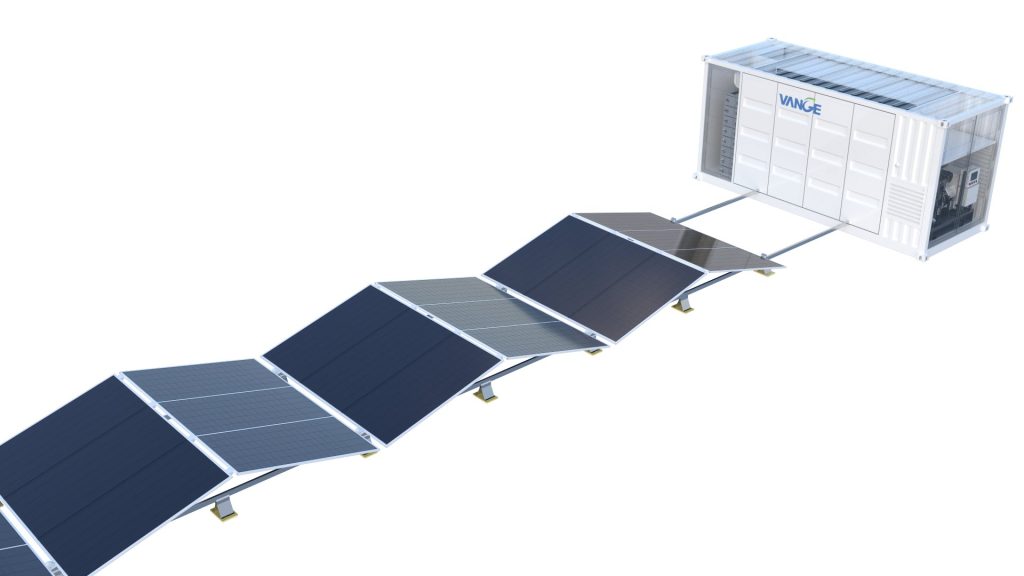
>The schematic below shows how the three sources share the bus through the EMS.
>Speed and mobility decide this step. Remote construction sites evolve: the batching plant moves, the camp relocates, the excavation front shifts. Fixed civil infrastructure — foundations, conduits, permitting — fights that reality.
>A containerized microgrid deploys in under 3 hours with no civil works, and it moves with the project. The foldable solar container’s single-side deployment means the array unfolds on site and folds back for transport, so the same asset serves multiple phases or multiple projects. Fixed builds win only when the site is permanent and the grid is genuinely nearby.
>Weigh total cost of ownership, not just capital: transport, installation, dismantling, and redeployment all favor the container. The containerized solar turnkey solution expands on deployment and relocation economics.
>Many remote sites eventually get a grid connection, or share one intermittently. Design for both states from the start so you are not rewiring later.
>The single-line diagram below shows the standard topology.
>A hybrid microgrid is low-maintenance, not no-maintenance. Specify O&M up front so availability stays high across the build.
>A simple monitoring checklist keeps the team honest:
| Parameter | Target | Action if breached |
|---|---|---|
| Battery SOC overnight | > 30% | Check PV sizing |
| Diesel run hours / week | Falling | Healthy — solar covering load |
| Module soiling loss | < 5% | Schedule cleaning |
| Inverter temperature | < 55°C | Verify ventilation |
>The seven steps above are your field-ready framework for specifying a hybrid microgrid on any remote build. The fastest way to turn the checklist into a sized system is our free Configurator: enter your loads and site, and it returns a solar-storage-diesel configuration in about five minutes.
>Try the free solar-diesel-storage microgrid Configurator to design your off-grid power system, or contact PORTA for a site-specific assessment tailored to your project phase and Saudi location.
>It depends on your daily energy consumption and peak load, not a single rule of thumb. A 78 kWp foldable solar container can offset a large share of daytime load on a mid-size site, but correct sizing requires the load audit from Steps 1–2 and local irradiance. The Configurator handles this in minutes.
>Yes — if solar and battery are sized to cover all loads, including cloudy periods and peaks. In practice, most remote construction sites keep a diesel generator as backup for extended poor-weather stretches and as insurance for critical loads, which is exactly what the all-in-one hybrid configuration provides.
>A PORTA foldable solar container deploys in under 3 hours with no civil works, and mobile BESS units set up similarly fast. That is the core advantage over fixed infrastructure, which can take weeks of permits and construction.
>The main tasks are periodic solar-module cleaning (critical in dusty sites), battery thermal checks, and generator service scheduled by run hours rather than calendar. Remote monitoring flags most issues before they become downtime.
Get a customized technical proposal and a capacity-ready quotation. Response within 24 hours.
Email: Jayden@solarstoragediesel.com
WhatsApp: +966 539412006
Riyadh, Saudi Arabia | Nanjing, China
Get a customized technical proposal and pricing for our mobile energy solutions.
Tell us about your requirements and we’ll build a solution.
Ask me anything about solar-storage-diesel hybrid microgrids!