


This Week in 60 Seconds: Zimbabwe switched on its largest mining microgrid (11 MWp PV + 30 MWh storage + 4 MW diesel, 50-day build, 85%+ renewable share). Diesel-plus-storage hybridization keeps proving itself as the fastest ROI path for remote sites - 18-25% fuel savings from simple genset-battery integration, 40-70% engine runtime reduction in full hybrids. And Saudi Arabia's microgrid market is forecast to grow at 28% CAGR with its first large off-grid mine solar plant now under construction.
If you run an off-grid mine, camp, or industrial site, the economics of solar + storage + diesel are no longer a debate. This week’s projects show exactly how much diesel – and money – can be displaced, and how fast hybrid systems are scaling across Africa and the Middle East.
Three numbers worth remembering from this edition: 85%+ renewable supply in Zimbabwe’s new mining microgrid, USD 0.12-0.22/kWh hybrid LCOE versus USD 0.44-0.72/kWh diesel-only in Saudi Arabia, and a 2.5-4 year typical payback for well-sized hybrid systems. The template for the future of remote power is now public, bankable, and repeatable.
On August 16, 2026, the Riddhi Mining solar-storage-diesel microgrid in central Zimbabwe was officially commissioned – the largest mining microgrid in the country and a landmark off-grid project for Chinese contractors in Africa.
| Parameter | Value |
|---|---|
| Solar PV | 11 MWp (bifacial modules) |
| Battery storage | 30 MWh |
| Diesel backup | 4 MW (4 x 1 MW gensets) |
| Grid voltage | 10 kV direct supply to mine network |
| Renewable share | >85% of energy from PV + storage |
| Supply guarantee | 24/7 operation, >330 supply days/year, fully off-grid |
| Build time | 50 days |
| Diesel displaced | >90% of previous consumption |
| Fuel cost savings | RMB 50-60 million/year (~USD 7-8.4 million) |
| Cost of energy reduction | ~50% vs. diesel-only |
The system uses grid-forming battery inverters to suppress inrush current from heavy mine equipment start/stop, holding voltage deviation within ±2% and frequency at 50 Hz ±0.1 Hz – critical for crushers, mills, and pumps in harsh operating conditions.
Why it matters: Zimbabwe sits on 43% of Africa’s population without reliable power. Remote mines that previously ran on 100% diesel now have a proven, bankable template for cutting fuel spend in half while keeping the diesel fleet as a last-resort backup – exactly the architecture we design around at PORTA.
Junda Power is scaling its DRC mine microgrid from a Phase I PV+storage+diesel system to a 10.2 MWp PV + 5 MW/10 MWh BESS + 8 x 1.8 MW gensets + 39.6 MW hydro interconnection. The EMS dispatch priority runs PV > hydro > storage > diesel, supports grid-connected, islanded, and seamless transfer modes, and handles 7 MW ball-mill starting impact via 10 kV architecture. Diesel is being pushed to the bottom of the dispatch stack.
Runma Solar’s 5.2 MW PV + 12 MWh storage + diesel backup system is now feeding a remote mine that previously ran on three 1,000 kVA gensets with no grid access. Expected output: 10.2 GWh/year of clean power with 24/7 supply. The operator reports stable voltage/frequency for precision equipment and significantly lower fuel logistics.
The Kansanshi copper project is pairing 100 MW of solar with 40 MWh of storage, targeting full energy autonomy by 2026 – one of the clearest signals that large African miners are moving from diesel-plus-pilot-solar to renewables-first with diesel standby.
Ma’aden’s Al Baitha bauxite mine is building an 8 MWp ground-mounted PV + 30 MWh BESS off-grid plant under a 30-year PPA with Emerge (Masdar-EDF JV). Construction is underway with Arabian Qudra as EPC. Expected outcomes:
| Segment | 2025 | 2032 | CAGR |
|---|---|---|---|
| Saudi microgrid market | USD 290 M | USD 1,520 M | 28.0% |
| Saudi industrial microgrids | USD 14.8 B | USD 33.6 B | 12.4% |
Combine this with Saudi Arabia’s 26 GWh storage mandate by 2027 and the MEA off-grid BESS CAGR of 26.1% (Mordor Intelligence), and the demand side for hybrid off-grid power in the Kingdom is unambiguous: mines, camps, and industrial zones are all being pushed toward solar + storage + diesel architectures.
Across this week’s case studies and market data, the same savings ranges appear repeatedly:
| Metric | Diesel-only | Hybrid (solar/storage/diesel) | Improvement |
|---|---|---|---|
| Fuel consumption (L/kWh) | 0.28-0.35 | 0.08-0.12 | 60-70% reduction |
| Genset runtime (hybrid controls) | 24/7 base load | dispatch on demand | 40-70% reduction |
| Simple genset + battery (no PV) | baseline | - | 18-25% fuel saving |
| LCOE - remote Saudi mine | USD 0.44-0.72/kWh | USD 0.12-0.22/kWh | 40-60% lower |
| Maintenance cost | 0.08-0.12 SAR/kWh | 0.03-0.05 SAR/kWh | 50-60% lower |
| Availability | 95-98% | 99.5%+ | +1-4 pts |
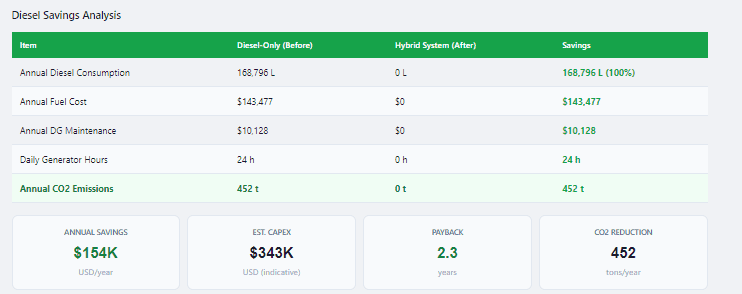
Worked example (from Australian Mining): a 60 kVA genset serving a site compound burns up to 56,064 L of diesel/year. Replacing it with a BESS + 45 kVA genset hybrid cuts consumption by ~21,792 L/year and ~59 tonnes of emissions – without reducing reliability.
Market-scale confirmation: the global solar-storage-diesel-charging hybrid market is forecast to exceed RMB 320 billion in 2026, up 68% YoY, with off-grid microgrids (islands, remote villages, mines) accounting for 42.9% of installations. The IndexBox hybrid genset market is growing at ~14.8% CAGR, and Asia-Pacific hybrid solar-wind-diesel systems are projected to grow from USD 2.8-3.4 B (2026) to USD 8.5-10.5 B (2035) at 12-14% CAGR – driven by remote-site diesel costs of USD 0.30-0.50/kWh vs. hybrid LCOE of USD 0.18-0.35/kWh.
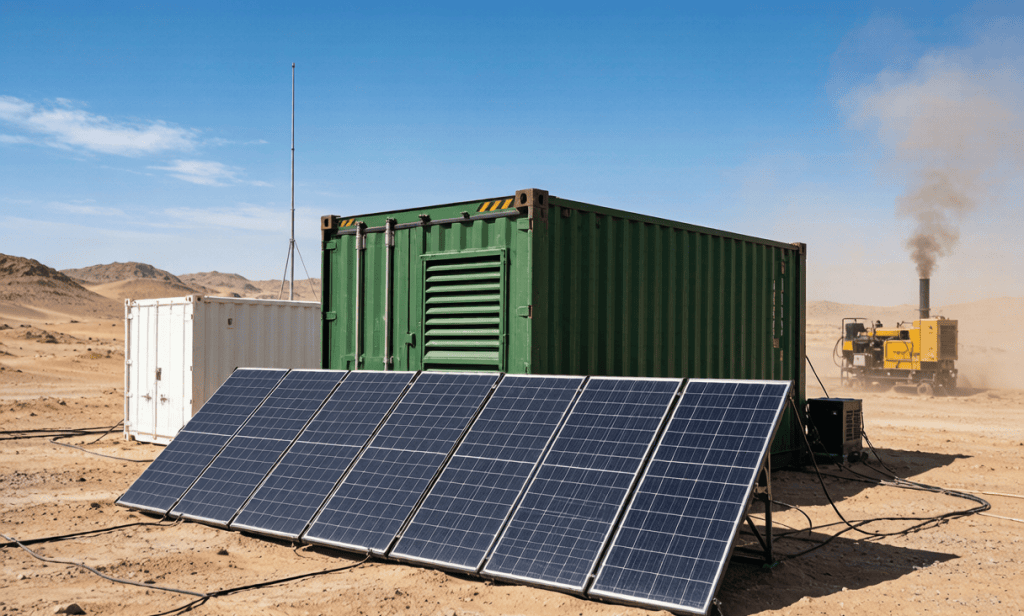
Every project this week shares the same DNA: solar + storage as the workhorse, diesel as the insurance policy, and an energy management system deciding when each runs. The economics are now overwhelmingly in favor of hybridization:
That is why PORTA builds foldable solar containers, mobile BESS units, and hybrid all-in-one microgrids – pre-engineered, containerized systems sized for exactly these economics. No custom engineering, no 12-month delivery cycle, no stranded diesel fleet. Just a hybrid microgrid that deploys on site, runs the solar first, charges the battery, and calls the generator only when it must.
If you are planning a new camp, mine extension, or industrial site, run your own numbers in the free PORTA Microgrid Configurator – it sizes the PV, battery, and diesel fleet from your load profile and shows the 10-year cash flow and payback in minutes. New to the tool? Our visual step-by-step guide walks through every screen.
Next week we look at diesel generator wet stacking in hybrid microgrids – the single most common failure mode when gensets run underloaded, and how battery dispatch strategies prevent it. Follow PORTA on LinkedIn to get each weekly insight delivered.
Run your own site numbers in the free Microgrid Configurator - PV, battery, and diesel sizing with 10-year cash flow and payback.
Launch the Free Configurator →For a detailed engineering review of your site, contact the PORTA team at jayden@solarstoragediesel.com.
Field data from this week's projects shows 60-70% fuel reduction for full solar + storage + diesel hybrids, 40-70% genset runtime reduction, and 18-25% savings even from a simple genset-plus-battery retrofit without solar.
Grid-forming battery inverters act as the voltage and frequency reference for the microgrid, unlike grid-following inverters that depend on the grid or a running genset. They absorb motor starting inrush, hold voltage within +/-2%, and enable multi-unit black start - critical for crushers, mills, and pumps.
Standard 50-250 kW containerized modules deploy in 4-8 weeks versus 6-12 months for custom-engineered plants. PORTA's foldable solar containers and mobile BESS units are built on exactly this model.
With remote-site diesel at USD 0.30-0.50/kWh and hybrid LCOE at USD 0.18-0.35/kWh, typical payback runs 2.5-4 years depending on solar resource and site load. The free PORTA Configurator calculates this for your specific site.
Data sources: public project announcements (Aug 10-16, 2026), industry market reports (IndexBox, Mordor Intelligence, Mobility Foresights, GlobalData), and published techno-economic studies. PORTA – portable solar, storage & diesel hybrid microgrids for remote industry.
Get a customized technical proposal and pricing for our mobile energy solutions.
Tell us about your requirements and we’ll build a solution.
Ask me anything about solar-storage-diesel hybrid microgrids!