


30-Second Summary: Islands face the world's toughest off-grid power challenge — diesel delivered by barge at $1.20/L, salt-corroded generators, and fragile fuel supply chains. Five global island microgrid projects prove that solar-diesel-storage hybrid systems cut diesel consumption by 70-85%, reduce power costs by up to 80%, and deliver 99%+ availability. Saudi Arabia's Red Sea coast — with 90+ islands and Vision 2030 tourism development — is the next frontier.
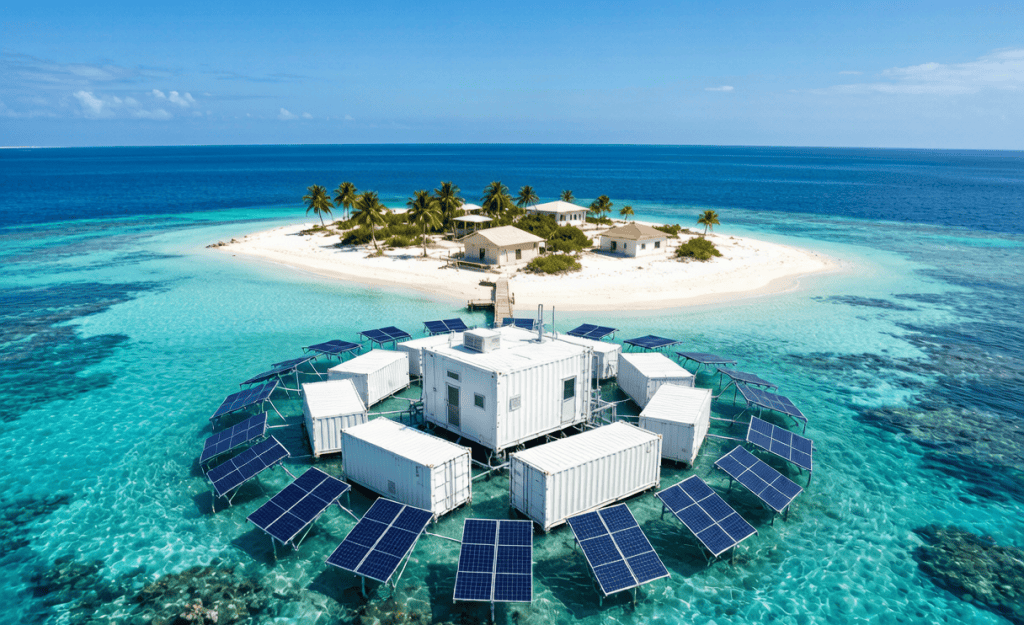
Islands are beautiful. They are also the hardest places on Earth to keep the lights on.
Cut off from mainland power grids, most islands have historically relied on diesel generators for 100% of their electricity. That means every drop of fuel must arrive by barge or small boat — a logistics chain that is expensive, fragile, and environmentally devastating. On remote islands, diesel costs can reach $1.20 per liter or more, making island electricity among the most expensive in the world.
But a revolution is underway. From the Pacific to the Red Sea, island communities and industrial operators are deploying solar-diesel-storage hybrid microgrids that cut diesel consumption by 70-85%, stabilize power supply, and slash electricity costs. Saudi Arabia — with its 90+ Red Sea islands and ambitious tourism development plans — is positioned to become a global leader in island microgrid deployment.
This article examines five real-world island microgrid projects from around the world, extracts the engineering and economic lessons they teach, and explains how PORTA’s containerized hybrid microgrid solutions can be deployed on Saudi islands and coastal sites.
Off-grid power is challenging anywhere. But islands face a unique combination of penalties that make diesel-only systems especially costly and fragile:
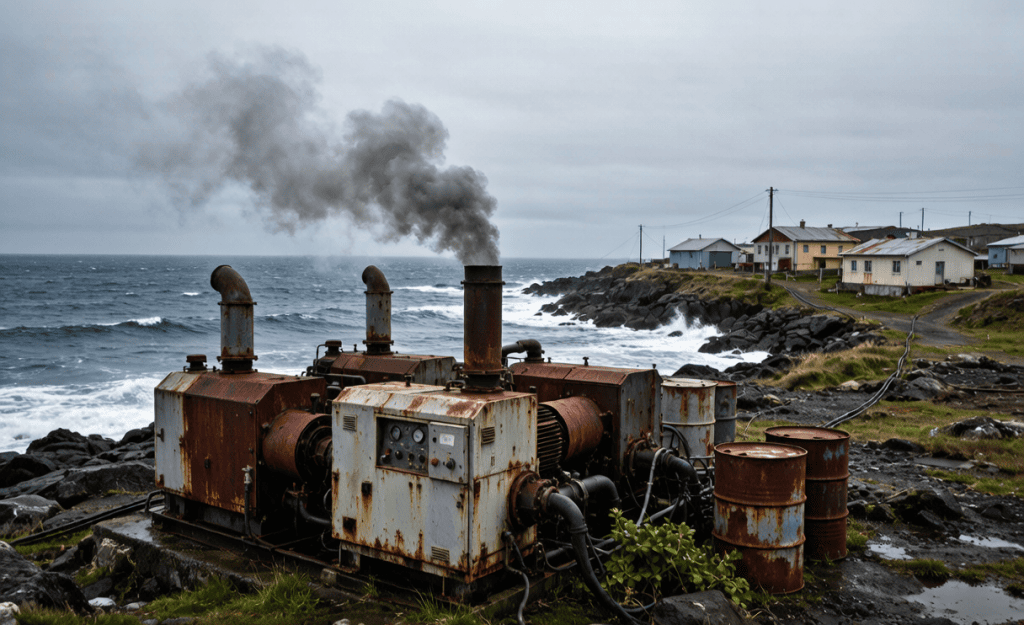
The result is a power system that is simultaneously the most expensive and the least reliable. Island operators often pay 3-5 times the mainland electricity rate while enduring more outages. This is the gap that hybrid microgrids close.
Theory is one thing. Field data is another. Here are five island microgrid projects from around the world that have been commissioned, measured, and verified — each demonstrating a different facet of the hybrid approach.
A remote Southeast Asian island with 3,200 residents and eco-resorts was 100% diesel-dependent. Three aging 500kVA gensets ran 18 hours a day. Diesel was delivered by barge every 45 days at $1.20/L. Frequent fuel shortages disrupted water desalination, telecom backhaul, and resort operations.
The solution: a 2MW/4MWh hybrid BESS integrated with existing 1.2MWp solar PV. The system uses dual 1MW grid-forming PCS units with BYD LFP battery modules, managed by an intelligent EMS with 72-hour load forecasting. The EMS logic: solar first, battery second, diesel starts only at 22% SOC.
Results: 72% diesel reduction, 99.3% availability, and full black-start capability. The gensets now run only during extended cloudy periods, and the island’s water desalination plant operates 24/7 without interruption.
Dongji Island, off China’s east coast, was connected to the mainland by a 35kV submarine cable — but cable faults took 1-2 weeks to repair, leaving the island in darkness. The solution: China’s first self-healing island microgrid, commissioned in March 2024.
The system combines 50kW of solar PV, 1MW of battery storage, and the existing 4.3MW diesel station as backup. The key innovation is the edge control system that autonomously detects grid faults, isolates the problem, and switches to island mode in seconds — not minutes. When a mainland power fault occurs, the microgrid seamlessly transitions to solar + battery + diesel operation without human intervention.
In June 2025, the system proved itself in a real-world test: a mainland grid fault was detected and isolated automatically, with critical loads transferred to stored solar energy and diesel backup — all before any human operator could respond.
Sanmen Island, off Guangdong province, was a classic diesel-dependent island. Residents paid over 3 RMB per kWh (about $0.42) for electricity — if they could get it. Diesel generators ran only a few hours a day, and residents rationed their power use.
In December 2024, the island’s first-phase microgrid was commissioned, with a larger second phase following in August 2025. The system integrates wind, solar, and battery storage into a multi-energy complementary microgrid. Daily electricity consumption is 4,600 kWh, while the microgrid generates up to 6,000 kWh per day — surplus power now supports small fish processing operations.
Results: Electricity cost dropped from $0.42/kWh to $0.09/kWh — an 80% reduction. Annual diesel savings: 350 tons. Annual CO2 reduction: 1,110 tons. Residents now use refrigerators, air conditioners, and other appliances that were previously unaffordable to operate.
Chishan Island, a small fishing island in Fujian province with 52 households, was entirely dependent on diesel generators. Undersea cable was deemed too expensive and fragile. In April 2025, China’s first fully off-grid island microgrid in Fujian was commissioned.
The system combines two 40kW wind turbines, 20kW of solar PV, and a 200kWh battery storage system — with diesel as emergency backup only. The microgrid operates in 100% off-grid mode, with millisecond-level power recovery during faults. Surplus electricity is used for ice making and water pump pressurization.
Results: 30 tons of diesel saved annually, 201.71 tons of CO2 reduced. The system supports future load growth from tourism, seawater desalination, and aquaculture for 5-10 years.
A Fiji-based industrial facility was 100% diesel-powered, running generators 10 hours a day with an average load of 500kW and peaks up to 1,100kW. Fiji receives over 2,500 hours of sunlight per year, but 60% of island electricity still came from diesel.
The solution: a 1.7MWp solar system with 1.5MW/2.89MWh battery storage. The design philosophy is ‘solar first, storage supports, diesel backs up.’ In normal weather, solar provides 67% of power and storage provides 33%, with the diesel generator completely off. During Fiji’s three-month typhoon/rain season, the system intelligently shares load between storage and diesel.
Results: Near-complete diesel displacement during normal weather. The system has become a replicable model for Pacific island nations and other power-scarce regions facing extreme weather challenges.
| Project | Location | System | Diesel Reduction | Key Outcome |
|---|---|---|---|---|
| Hybrid BESS | SE Asia | 2MW/4MWh + 1.2MWp PV | 72% | 99.3% availability |
| Self-Healing Grid | Dongji, China | 50kW PV + 1MW BESS | Significant | Millisecond fault recovery |
| Multi-Energy Grid | Sanmen, China | Wind+PV+Storage | ~85% | 80% cost reduction |
| Wind+PV+Storage | Chishan, China | 40kW wind + 20kW PV + 200kWh | ~95% | Diesel nearly eliminated |
| Solar+BESS | Fiji | 1.7MWp PV + 2.89MWh | ~67-85% | Storm-resilient design |
Saudi Arabia doesn’t need to look abroad for island microgrid inspiration. The Red Sea Global project — covering 28,000 km2 of coastline and 90 islands along Saudi Arabia’s western coast — is already the world’s largest off-grid renewable energy system.
Powered by 400MW of solar PV and 1.3GWh of battery storage across 6 energy stations and 607 battery containers, the Red Sea destination is the first development of its kind to be powered 100% by renewable energy. Biodiesel generators serve as emergency backup only.
The system delivers over 100 million kWh of green electricity annually to 50 hotels, an international airport, water desalination plants, wastewater treatment, and district cooling. In May 2024, when a storm knocked out multiple substations, the system’s black-start capability restored power in seconds — a process that would have taken hours on a traditional grid.
The Red Sea project proves that large-scale island and coastal microgrids are not just feasible in Saudi Arabia — they are already operational. The question for smaller island operators, resort developers, and industrial sites is: how do you deploy the same architecture at a smaller scale, faster, and at lower cost?
From these five global cases plus the Saudi Red Sea benchmark, seven engineering and economic lessons emerge that are directly applicable to any Saudi island or coastal microgrid project:
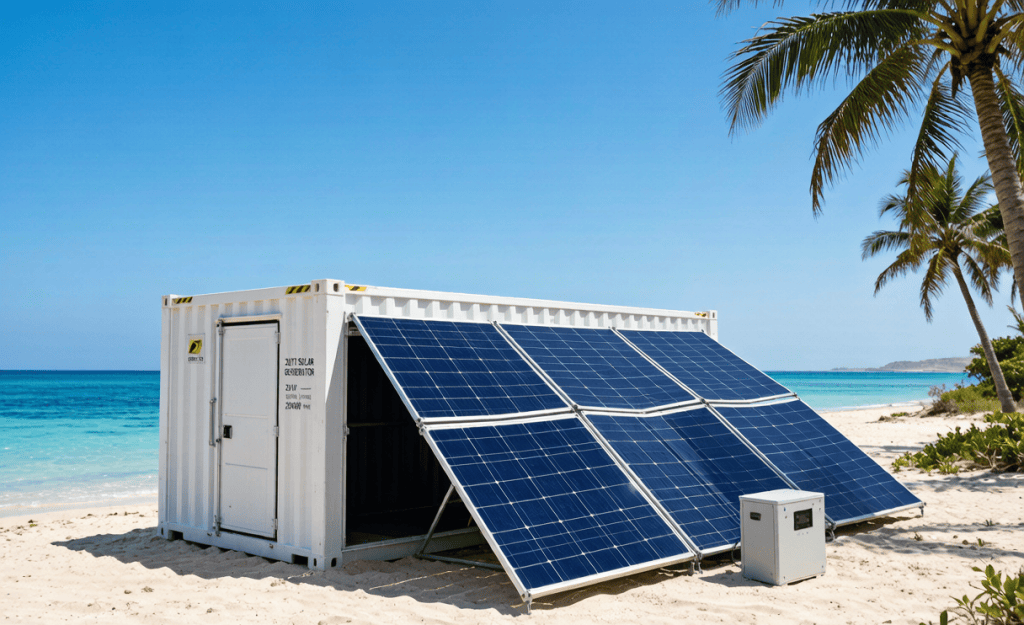
PORTA’s hybrid microgrid containers are engineered specifically for the kind of remote, harsh-environment deployment that islands demand. The flagship PBD78-60 All-in-One Mobile Microgrid Station integrates solar, battery, and diesel into a single 20-foot container:
| Parameter | Specification |
|---|---|
| PV Capacity | 78 kWp (120 x LONGi 650Wp modules) |
| Inverter Power | 60 kW (PORTA brand) |
| Battery Capacity | 128 kWh (LFP, HIGEE cells) |
| Diesel Generator | 75 kVA (WEICHAI WPG66-16) |
| Container Size | 6058 x 2438 x 2896 mm (20ft standard) |
| Total Weight | 20,000 kg |
| Deployment Time | Under 3 hours, no civil works |
| Fuel Reduction | Up to 80% vs diesel-only |
| Operating Temperature | -25C to 60C |
| EMS Logic | Solar first, Battery second, Diesel last |
The foldable solar array deploys in a wave/corrugated pattern — 40 alternating faces that capture morning sun on one side and afternoon sun on the other, maximizing daily energy yield without requiring a fixed orientation. The entire array slides back into the container for transport or severe weather protection.
For larger island loads, PORTA’s 97kWp Foldable PV+BESS (100kW/258kWh) and 250kW Long-Duration ESS (723kWh) can be combined to scale capacity. Multiple containers can be paralleled on a common AC bus, allowing phased capacity expansion as island demand grows.
Consider a typical Saudi Red Sea island scenario: a small resort or industrial facility with a peak load of 50kW and daily energy consumption of 600 kWh. Currently powered by diesel generators, with fuel delivered by boat.
| Parameter | Diesel-Only | PORTA Hybrid |
|---|---|---|
| Daily Energy | 600 kWh | 600 kWh |
| Peak Load | 50 kW | 50 kW |
| Diesel Price (delivered) | $1.00/L | $1.00/L |
| Annual Diesel Consumption | ~165,000 L | ~35,000 L |
| Annual Fuel Cost | $165,000 | $35,000 |
| Annual Maintenance | $25,000 | $8,000 |
| Annual Total Opex | $190,000 | $43,000 |
| Annual Savings | — | $147,000 |
| Diesel Reduction | — | ~79% |
With a PORTA PBD78-60 system investment of approximately $120,000-$150,000 (depending on configuration and logistics), the payback period is under 12 months for this island scenario. Over a 10-year system life, total savings exceed $1.4 million — before counting carbon credits, ESG reporting benefits, and reduced supply chain risk.
For larger island installations (resort islands, industrial facilities), the savings scale proportionally. A 200kW peak load island switching from diesel to a 250kW/723kWh BESS + foldable PV system can save $400,000-$600,000 per year in fuel and maintenance costs.
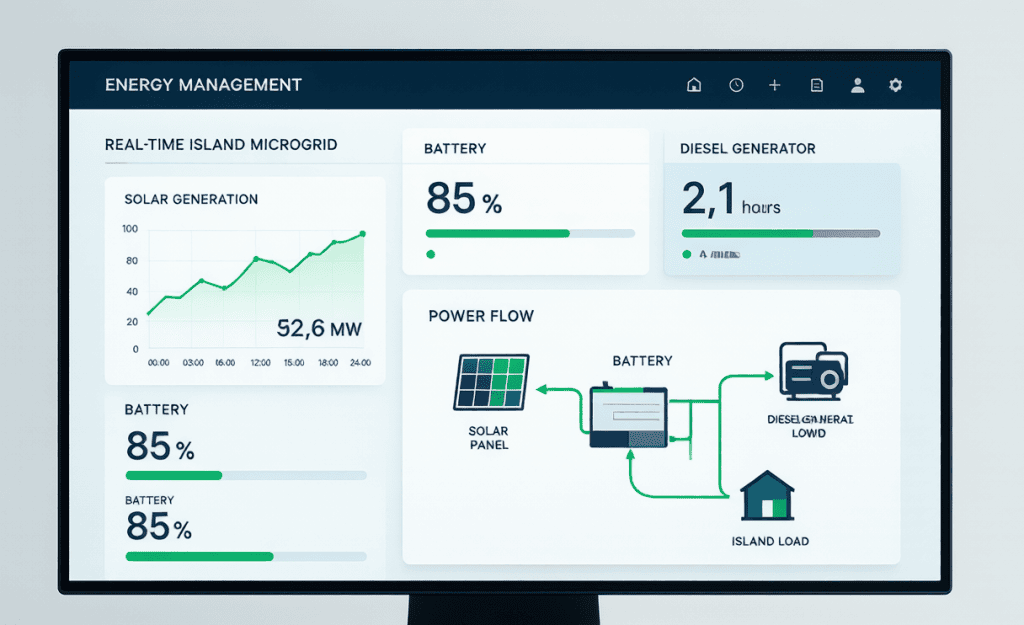
Island deployment is not just about generating power — it’s about surviving the environment. PORTA’s containerized systems are engineered for the specific challenges of Saudi Red Sea island conditions:
Saudi Arabia’s Vision 2030 has put island and coastal development at the center of its tourism diversification strategy. The Red Sea Project, Amaala, and multiple private island developments along the Kingdom’s 2,000+ km of coastline all require reliable, clean, off-grid power.
The Red Sea Global project has proven that 100% renewable island power is feasible at utility scale. But not every island needs a 400MW solar farm and 1.3GWh of storage. Most Saudi island projects — private resorts, fish farms, desalination stations, coastal construction camps, telecom repeaters — need 50kW to 500kW of reliable, clean power that can be deployed quickly and scaled incrementally.
This is exactly the gap PORTA’s containerized microgrids fill. One container. One deployment. Solar, battery, and diesel backup — pre-integrated, pre-tested, and ready to power an island within hours of arrival.
The five global case studies in this article prove that island off-grid microgrids are no longer experimental. From 72% diesel reduction in Southeast Asia to 80% cost reduction on Sanmen Island to the world’s largest off-grid system on Saudi Arabia’s own Red Sea coast — the technology is proven, the economics are compelling, and the engineering is mature.
For Saudi island and coastal project developers, the question is not whether to adopt hybrid microgrids — it’s how quickly they can deploy them. Every month of diesel dependency is a month of excessive fuel costs, supply chain risk, and missed ESG targets.
PORTA’s containerized solutions bring the proven architecture of the Red Sea Global project down to a scale that any island operator can afford and deploy. One container. One day. One island transformed.
Tell us about your island or coastal project — location, load profile, and current power setup. Our engineering team will design a custom PV + BESS + DG microgrid solution and deliver a detailed ROI analysis within 48 hours.
Share your island project details. We'll size the right hybrid microgrid and return a detailed savings estimate within 48 hours.
Request Your Free AssessmentGet a customized technical proposal and pricing for our mobile energy solutions.
Tell us about your requirements and we’ll build a solution.