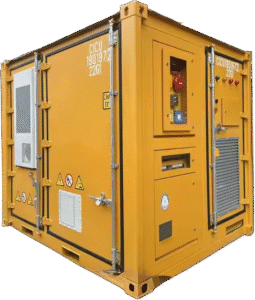



Running generators at low load causes engine damage (“Wet Stacking”). Adding a Battery (BESS) solves this. You can configure it in Parallel (to shrink generator size and save CapEx) or Series (to run the engine efficiently and save massive OpEx).
Every site manager knows the headache: You have a 500kVA generator running to power a site office or a night shift, but the actual load is only 50kW.
It feels like using a sledgehammer to crack a nut.
Running a diesel engine at 10% capacity isn’t just wasteful—it’s destructive. It leads to “Wet Stacking” (carbon buildup in the exhaust system), which results in black smoke, power loss, and frequent maintenance overhauls.
The solution is not just “buying a smaller generator,” because you still need that peak power for crane startups or crusher motors. The real solution is the Battery Energy Storage System (BESS). But how you connect the battery changes everything. Here are the two main architectures.
Think of this like a standard Hybrid Car (HEV), like a Toyota Prius. The engine runs most of the time to carry the base load, but the electric motor kicks in when you step on the gas to provide extra power.
Instead of buying a 500kVA generator just for a 10-second peak, you can buy a 200kVA generator and let the battery handle the spikes. You save money on the machine purchase.
Think of this like an Extended-Range EV (EREV), like a Chevy Volt or Li Auto. The car runs on battery power, and the engine only turns on to recharge it.
Your generator might only run for 4 hours a day instead of 24. This drastically cuts fuel consumption (better Specific Fuel Consumption) and extends maintenance intervals by 500%.
Both methods beat a standalone generator, but they serve different project goals.
| Feature | Parallel Mode (Booster) | Series Mode (Range Extender) |
|---|---|---|
| Best For | Heavy startup loads (Cranes, Pumps) | Variable loads (Camps, Offices) |
| Generator Role | Always running (Base load) | Start/Stop (Charging only) |
| Fuel Saving | Moderate (10-20%) | High (50-70%) |
| Noise Level | Standard | Silent (Most of the time) |
Both methods beat a standalone generator, but they serve different goals. The industry trend is moving towards Mode 2 (Range Extender) because it decouples generation from consumption, offering the highest fuel savings and preparing sites for a Net-Zero future.
Send us your load profile (power & working hours). We will simulate the fuel savings for both scenarios to help you decide.Don’t just guess. [Use our Free ROI Calculator] to see exactly how much fuel a hybrid system can save on your specific site.
Get a customized technical proposal and pricing for our mobile energy solutions.
Tell us about your requirements and we’ll build a solution.
 Optimized by Seraphinite Accelerator