


30-Second Summary: Remote gold mines pay $1.00-1.80/L for diesel delivered to site, with energy costs exceeding $3.5 million/year for mid-sized operations. Six real-world gold mine microgrid projects — from B2Gold's Fekola in Mali (52MW solar) to Northern Star's Porphyry in Australia (4.4MW solar) — prove hybrid solar-diesel-storage systems cut fuel consumption by 60-80% while improving power reliability. With Saudi Arabia's $2.5 trillion mining boom accelerating under Vision 2030, PORTA's containerized microgrid solutions offer a rapid-deployment path to lower-cost, lower-carbon mine power.
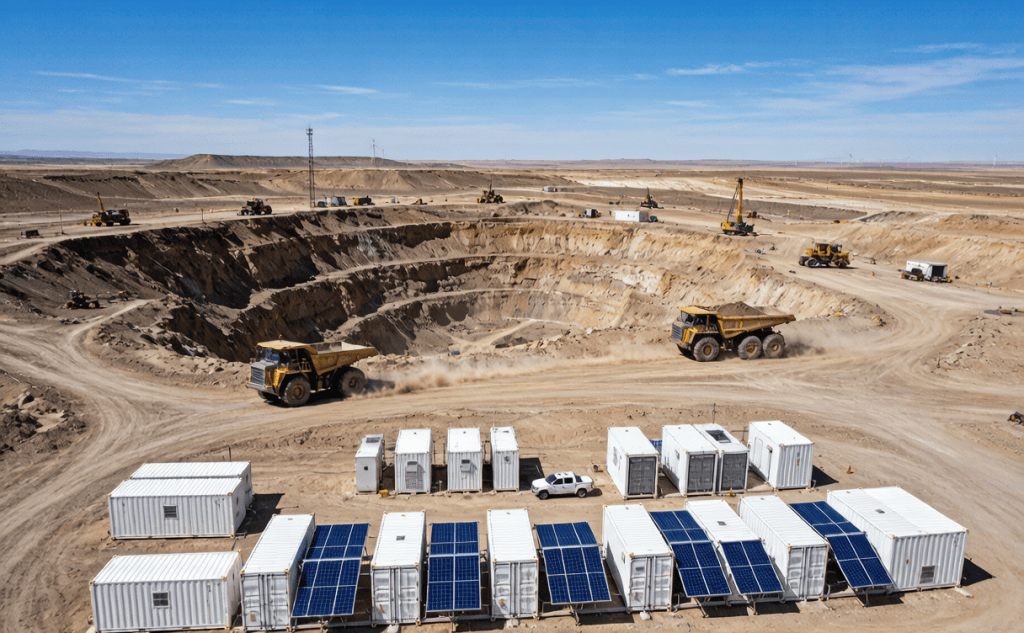
Gold doesn’t care where it is. It hides in the most remote corners of the planet — the Western Australian outback, the West African Sahel, the high Andes, the Saudi Arabian Shield. And where there’s gold, there’s mining. And where there’s mining, there’s an insatiable hunger for power.
For most remote gold mines, that power comes from one source: diesel generators. No grid connection. No pipeline. Just diesel — trucked, barged, or flown in at enormous cost, burned in generators that run 24 hours a day, 365 days a year.
The result is a financial and operational headache that most mining companies have learned to tolerate: energy as the single largest operating cost after labor, supply chains vulnerable to weather and geopolitics, and generators that demand constant maintenance in some of the harshest environments on Earth.
But that is changing — fast. A global wave of solar-diesel-storage hybrid microgrids is sweeping through the mining industry, and the data is compelling. This article examines six real-world gold mine microgrid projects, extracts the hard numbers, and shows how PORTA’s containerized solutions can bring the same transformation to Saudi Arabia’s booming gold mining sector.
Diesel-dependent mines face three compounding cost layers that together make remote mining energy among the most expensive industrial power on the planet:
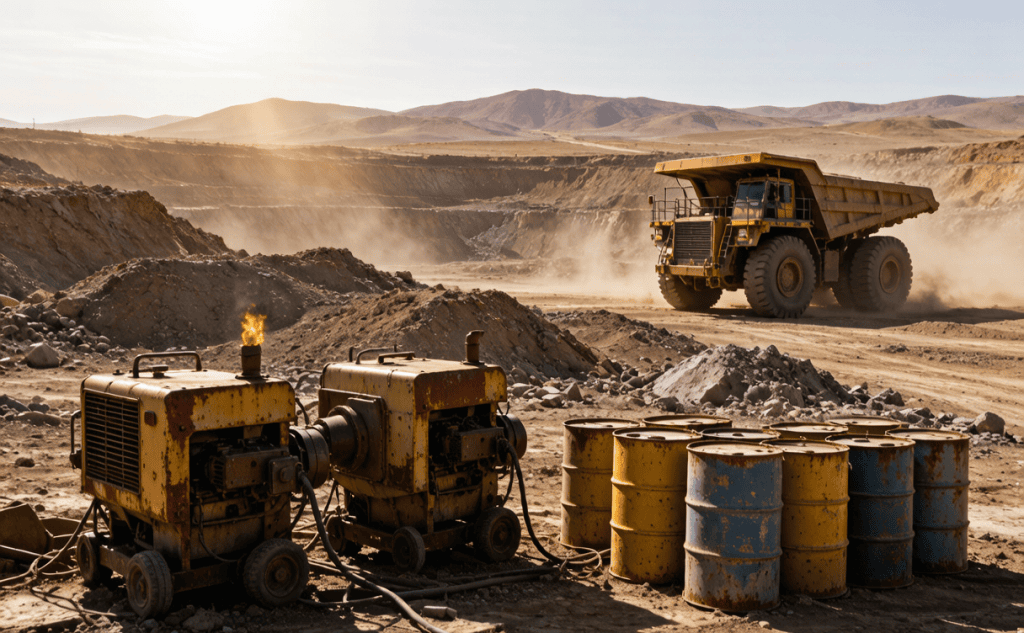
A diesel generator at 75% load consumes approximately 0.27 liters per kWh. For a mine paying $1.20/L delivered, that means each kilowatt-hour of electricity costs about $0.32 in fuel alone — before generator maintenance, oil changes, spare parts, or technician labor. Add those in and the all-in cost reaches $0.50-0.80/kWh. Compare that to grid-connected industrial power at $0.08-0.15/kWh and the mining industry’s energy cost disadvantage is stark.
Across four continents, gold mining companies are deploying hybrid microgrids and reporting dramatic results. Here are six projects that demonstrate the full range of what is possible — from incremental solar retrofits to complete off-grid renewable systems.
The Fekola Mine in Mali is one of the world’s largest off-grid gold mines — and now home to one of the largest off-grid hybrid energy systems in the entire mining industry. Located far from any grid connection, Fekola was designed from inception as a self-sufficient island operation, originally powered entirely by heavy fuel oil (HFO) generators.
In April 2021, B2Gold commissioned Phase 1: 30MW of solar PV plus 17.3MWh of battery storage integrated with the existing thermal plant. The results were immediate — during peak solar hours, only two or three thermal engines were needed instead of six. In 2024 alone, the hybrid system cut GHG emissions by approximately 38,000 tonnes of CO2e and saved around 13 million liters of HFO.
In early 2025, Phase 2 was commissioned, adding another 22MW of solar and 12.7MWh of battery storage — bringing total solar capacity to 52MW and storage to approximately 28MWh. The expanded system now supplies approximately 30% of the mine’s total electricity demand from solar, with HFO running as backup rather than baseload.
Key takeaway: Even a mine-scale operation with massive power requirements can achieve 30%+ solar penetration with hybrid storage. The modular, phased approach allowed B2Gold to validate performance with Phase 1 before committing to Phase 2.
In the remote terrain of Western Australia, the Porphyry Gold Mine faced the classic off-grid challenge: high diesel costs, extreme temperatures, and space constraints. Since 2022, the site had relied entirely on Aggreko-provided diesel generation.
Aggreko partnered with Northern Star Resources to deploy a 4.4MW relocatable solar farm with 2MW of battery storage, delivered through a 10-year Power Purchase Agreement (PPA). The solar plant uses 5B Maverick prefabricated units for rapid deployment. The system integrates seamlessly with the existing diesel power infrastructure — solar charges the battery during the day, battery discharges during evening peaks, and diesel generators ramp only when needed.
Results: 1.91 million liters of diesel saved annually — a reduction of 5,141 metric tons of CO2 emissions. The PPA model eliminated upfront capital costs for the mine operator. Aggreko bears the technology risk and performance guarantee; Northern Star pays only for the power consumed.
Key takeaway: The PPA model makes hybrid microgrids accessible to mines with limited capital budgets. Third-party financing transforms a capex decision into an opex saving from day one.
In late 2025, Beijing Yunmu Digital Energy partnered with AVIC International to deliver an off-grid ‘PV + Storage + Diesel’ microgrid for a large gold mine in Africa. The project target was clear: replace the mine’s near-total diesel dependency with a hybrid system that maintains 24/7 power reliability while cutting costs dramatically.
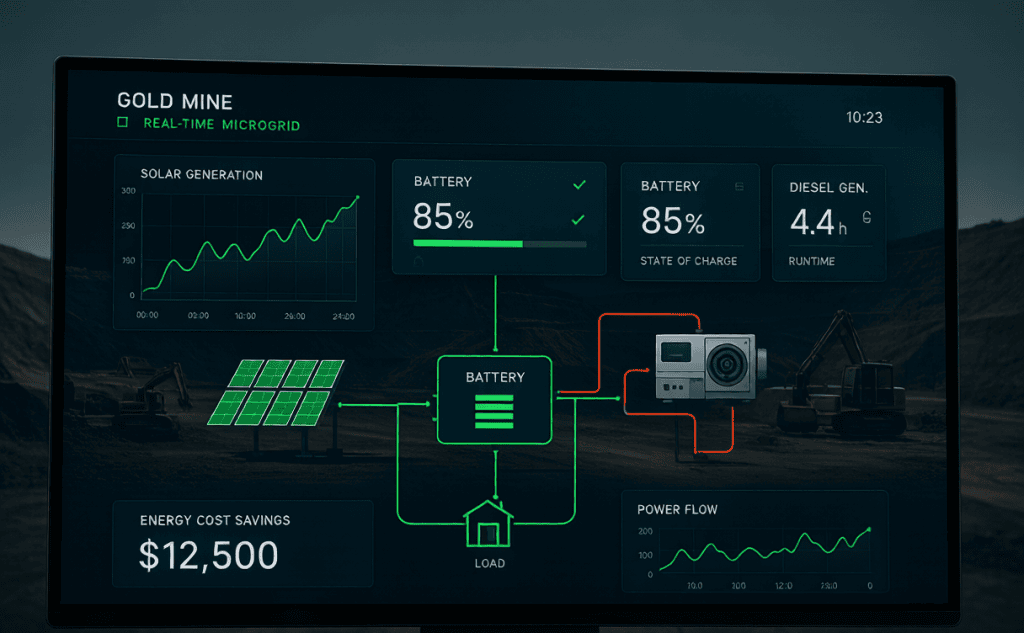
The system integrates solar PV as the primary energy source, battery storage for grid-forming support and PV smoothing, and diesel generators as emergency backup only. The EMS uses a proprietary intelligent scheduling algorithm that achieves a solar+storage supply ratio far exceeding industry benchmarks, reducing diesel from primary baseload to cold standby.
Results: Approximately 50 million RMB (~$7 million) in annual electricity cost savings. The system maintains voltage deviation within ±2% and frequency stability at 50Hz ±0.1Hz — critical for sensitive mining equipment. Yunmu’s technology has been validated across dozens of microgrid installations in similarly harsh African environments.
Key takeaway: Grid-forming battery storage is the critical enabler for high-renewable-penetration mine microgrids. The EMS must handle the complex load profiles of mining equipment — crushers, mills, conveyor belts — that create sudden, violent demand spikes.
In 2025, Côte d’Ivoire’s national power grid experienced sustained shortages that threatened production at the Abujar Gold Mine, one of Zhaojin Mining’s flagship overseas operations. The mine needed a solution fast — and it needed one that did not simply substitute one dependency (grid) for another (diesel).
Zhaojin deployed a 33.28MWp solar PV system with 37.5MWh of battery storage, integrated with the existing grid connection and diesel backup. The system operates in a multi-mode configuration: grid-connected when the national grid is stable, seamless transition to island mode during outages, and diesel as tertiary backup for extreme scenarios.
Results: The mine achieved continuous, stable production despite national grid instability. Electricity costs dropped significantly compared to the previous ‘grid + diesel’ model. The project also became the first large-scale mining new energy demonstration power station in Côte d’Ivoire after the country’s new energy law was enacted — a regulatory milestone that positions Zhaojin as a leader in sustainable mining.
Key takeaway: Hybrid microgrids deliver value beyond fuel savings. For mines connected to unreliable national grids, the reliability improvement — eliminating production stoppages from grid outages — can deliver more value than the fuel cost reduction alone.
Zambia is one of Africa’s most important mining countries, but its mines struggle with unreliable grid power and high diesel costs. The Ruida Mine microgrid project, built by SANY Silicon Energy and completed in late 2024, is the largest single-mine microgrid in Africa by scale.
The system integrates 13MWp of solar PV, 39MWh of battery energy storage, and diesel generator backup — all managed by an advanced EMS that optimizes solar self-consumption, battery charge/discharge cycles, and diesel runtime. From PPA signing to first grid connection took only 4 months — a speed that reflects SANY’s integrated engineering and construction capabilities.
Results: Dramatically reduced diesel consumption and electricity costs. The project demonstrates that large-scale mine microgrids are not theoretical — they can be designed, financed, built, and commissioned in months, not years. As a landmark China-Africa energy cooperation project, Ruida has become a replicable model for mining decarbonization across the continent.
Key takeaway: Speed matters. A mine losing money on diesel today does not want a three-year project timeline. Integrated manufacturers who control the solar, battery, and EMS supply chain can deliver turnkey systems in months.
The Syama Gold Mine in Mali, operated by Resolute Mining, faced the same diesel dependency challenge as most remote African mines. The solution: Aggreko’s hybrid energy-as-a-service contract combining solar, battery storage, and thermal generation into a single turnkey power solution.
Unlike a traditional equipment purchase, the hybrid contract means Aggreko owns, operates, and maintains the power system. Resolute pays a fixed rate per kWh consumed. The model transferred technology risk from the miner to the energy provider and eliminated the capital expenditure barrier.
Results: Approximately €2 million per month in energy cost savings — a 40% reduction in the mine’s cost of energy. The model has proven so successful that similar hybrid contracts now serve the Essakane mine in Burkina Faso (15MW solar saving 6 million liters of fuel per year) and the Granny Smith mine in Australia (1.67 million liters of diesel saved annually).
Key takeaway: The energy-as-a-service model is transforming mining power. When miners can buy reliable, lower-cost power without upfront investment, the decision to go hybrid shifts from ‘can we afford it?’ to ‘why haven’t we done this already?’
| Project | Location | System Size | Diesel/Fuel Savings | Key Metric |
|---|---|---|---|---|
| Fekola (B2Gold) | Mali | 52MW PV + 28MWh BESS | 13M L HFO/yr | 30% solar share |
| Porphyry (N. Star) | Australia | 4.4MW PV + 2MW BESS | 1.91M L diesel/yr | 5,141 tCO2 reduced |
| Yunmu Gold Mine | Africa | PV + Storage + Diesel | 50M RMB/yr savings | ±2% voltage stability |
| Abujar (Zhaojin) | Côte d'Ivoire | 33.28MWp + 37.5MWh | Significant | First mine solar in country |
| Ruida (SANY) | Zambia | 13MWp PV + 39MWh | Dramatic reduction | 4 months construction |
| Syama (Resolute) | Mali | Hybrid EaaS | 40% cost reduction | ~€2M/month savings |
Saudi Arabia is sitting on an estimated $2.5 trillion worth of mineral resources, and gold is at the center of the Kingdom’s mining ambitions. Under Vision 2030, mining has been designated the third pillar of the Saudi economy alongside oil and petrochemicals — with a target of growing the sector’s GDP contribution to SAR 281 billion (~$75 billion) by 2030.
The catalyst came in early 2025, when national mining champion Ma’aden announced a landmark gold discovery in the Makkah Region: 7.8 million ounces across four separate sites along a 100-kilometer corridor south of the existing Mansourah Massarah gold mine. Ma’aden CEO Robert Wilt declared these discoveries ‘have the potential to be the center of the world’s next gold rush.’
In August 2025, Ma’aden made a final investment decision on the Ar Rjum open-pit gold mine — designed to process 8 million tonnes of ore per year and produce 3.6 million ounces of gold over a 12-year life. Saudi Arabia currently produces around 250,000 ounces of gold annually; with Mansourah-Massarah, Ar Rjum, and new discoveries, the Kingdom has a credible path to the top 10 global gold producers.
Critically for the microgrid industry, over 60% of Saudi gold mining operations plan to use renewable energy by 2025, according to Saudi mining consulting data. Ma’aden’s Al Baitha Bauxite Mine already operates under a 30-year PPA for an 8MWp solar PV system with 30MWh of battery storage. The precedent is set.
The implications for off-grid power are enormous. Saudi Arabia’s gold deposits are concentrated in the Arabian Shield — a vast, remote geological formation stretching from the Red Sea coast deep into the interior. Many existing and planned mine sites have no grid connection. Diesel delivery to these locations involves 200-500km trucking distances through desert terrain. The economics of diesel-only power at Saudi mine sites mirror — and in some cases exceed — the African and Australian cases documented above.
Six projects across four continents reveal clear patterns. Here are the seven engineering and commercial lessons that any mine operator — in Saudi Arabia or elsewhere — should apply when evaluating hybrid microgrid adoption:
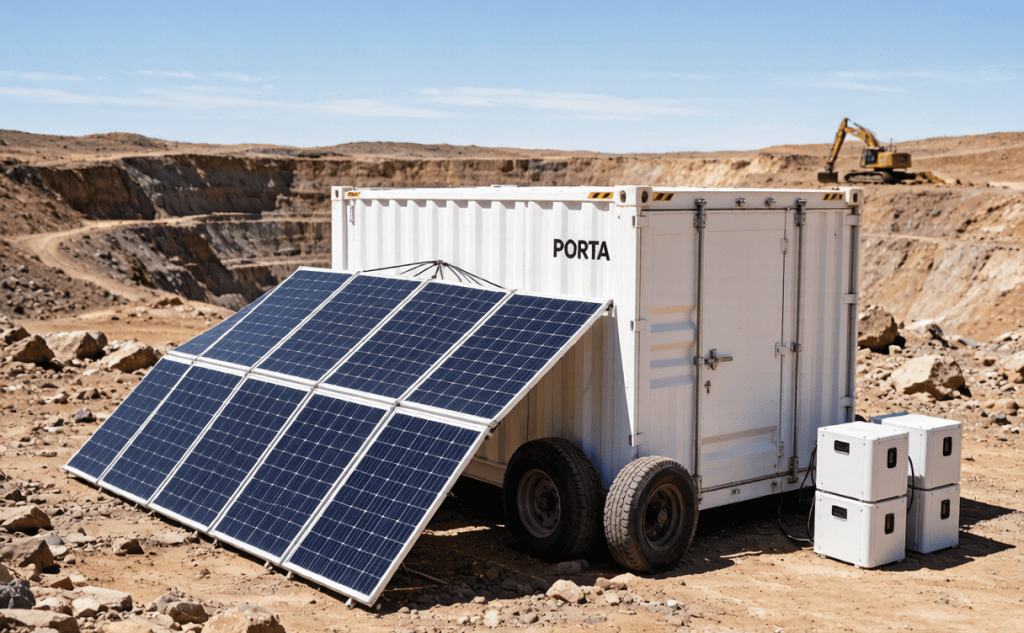
PORTA’s hybrid microgrid containers are engineered specifically for the remote, harsh-environment deployment that gold mines demand. The flagship PBD78-60 All-in-One Mobile Microgrid Station integrates solar PV, battery storage, inverter, and diesel generator into a single 20-foot standard container — a complete mine power solution that deploys in under 3 hours with zero civil works.
| Parameter | Specification | Relevance to Mining |
|---|---|---|
| PV Capacity | 78 kWp (120 x LONGi 650Wp) | Powers camp, admin, small processing |
| Inverter Power | 60 kW | Handles mining equipment surge loads |
| Battery Capacity | 128 kWh (LFP, HIGEE) | 4-6 hours night load for camps |
| Diesel Generator | 75 kVA (WEICHAI) | Backup for extended cloud/monsoon |
| Container Size | 6058 x 2438 x 2896 mm | 20ft standard — any truck/boat delivery |
| Total Weight | 20,000 kg | Standard container handling equipment |
| Deployment Time | Under 3 hours | No concrete pad, no crane (for container only) |
| Fuel Reduction | Up to 80% | From 24/7 diesel to ~5 hrs/day average |
| Operating Temp | -25C to 60C | Saudi desert summer + high-altitude winter |
| EMS Logic | Solar first, Battery, Diesel last | Maximizes fuel savings automatically |
The foldable solar array deploys in a wave/corrugated pattern — 40 alternating faces that capture morning sun on one side and afternoon sun on the other, maximizing daily yield without requiring a fixed orientation or solar tracking hardware. The entire array retracts into the container for transport, sandstorm protection, or site relocation.
For larger mining operations, PORTA’s product line scales: the 97kWp Foldable PV+BESS (100kW/258kWh) for medium processing camps, the 250kW Long-Duration ESS (723kWh) for heavy industrial loads, and the 130kWp pure PV container for maximum solar generation in high-irradiance regions. Multiple containers can be paralleled on a common AC bus for phased capacity expansion.
Consider a typical Saudi Arabian exploration or small production gold mine scenario: a remote camp with 50kW peak load and 600 kWh daily consumption, currently powered by two diesel generators running in rotation. Diesel is trucked 300km from the nearest depot at $1.20/L delivered cost.
| Parameter | Diesel-Only | PORTA PBD78-60 Hybrid | Savings |
|---|---|---|---|
| Daily Energy | 600 kWh | 600 kWh | — |
| Peak Load | 50 kW | 50 kW | — |
| Diesel Price (delivered) | $1.20/L | $1.20/L | — |
| Annual Diesel Consumption | ~165,000 L | ~35,000 L | 130,000 L |
| Annual Fuel Cost | $198,000 | $42,000 | $156,000 |
| Annual Generator Maintenance | $28,000 | $8,000 | $20,000 |
| Annual Total Opex | $226,000 | $50,000 | $176,000 |
| Diesel Reduction | — | ~79% | — |
| 10-Year Total Savings | — | — | $1,760,000 |
With a PORTA PBD78-60 system investment of approximately $130,000-$160,000 (depending on configuration and Saudi site logistics), the payback period is under 12 months. The system’s 20+ year design life means over $1.5 million in net savings after payback — before accounting for carbon credits, reduced supply chain risk, or the productivity value of reliable 24/7 power.
For larger production mines (200kW+), the savings scale dramatically. A PORTA 250kW/723kWh BESS combined with foldable PV can save $400,000-$700,000 per year. And for mines using the PPA/energy-as-a-service model — as demonstrated by the Porphyry, Syama, and Ruida projects — the mine achieves these savings with zero upfront capital expenditure.
Mining environments are uniquely punishing for electrical infrastructure. PORTA’s systems are engineered for the conditions that destroy standard industrial equipment:
Saudi Arabia’s mining transformation is not just about geology — it is about policy. The Mining Investment Law (2021) streamlined licensing, allowed 100% foreign ownership, and created a transparent investment framework. The Kingdom has committed $182 million to mineral exploration incentives that cover up to 25% of exploration costs, and the Saudi Industrial Development Fund covers up to 75% of project development costs.
Critically, Saudi Arabia’s energy policy is aligning with its mining ambitions. The national target of 50% renewable energy in the energy mix by 2030 creates a direct mandate for mining operations — especially new developments — to incorporate solar and storage from day one. The Ma’aden Al Baitha 30-year solar PPA is not an experiment; it is the template for every future Saudi mining project.
For international mining companies entering the Saudi market — and there are many, with exploration licenses surging 220% in 2025 — the infrastructure question is immediate: how do you power a remote exploration camp or production site in the Arabian Shield without waiting years for grid connection? The answer, as proven by six projects across four continents, is a containerized hybrid microgrid.
The six gold mine microgrid projects documented in this article are not pilot studies or academic papers. They are operational commercial systems — from Fekola’s 52MW of solar in Mali to Porphyry’s 1.91 million liters of diesel saved annually in Australia — that have been commissioned, measured, and validated in the field.
The pattern is unmistakable: solar-diesel-storage hybrid microgrids cut mining energy costs by 40-80%, reduce carbon emissions by thousands of tonnes annually, and — critically — improve power reliability compared to diesel-only systems. They can be financed through capex or opex models. They can be deployed in months, not years. And they work in the harshest environments on Earth.
For Saudi Arabia’s gold mining sector — expanding at an unprecedented rate under Vision 2030 with $2.5 trillion in mineral resources to unlock — the question is not whether hybrid microgrids will power the next generation of mines. It is how quickly they can be deployed. Every month of diesel dependency at a Saudi gold mine is a month of unnecessary fuel costs, supply chain risk, and carbon emissions.
PORTA’s containerized solutions bring the proven architecture of the world’s most successful mine microgrids to a scale that any exploration camp, processing site, or production mine can deploy. One container. One delivery. Solar, battery, and diesel backup — pre-integrated, pre-tested, and ready to power a gold mine within hours of arrival.
Tell us about your mining operation — location, load profile, current power setup, and expansion plans. Our engineering team will design a custom PV + BESS + DG microgrid solution, calculate your fuel savings, and deliver a detailed ROI analysis within 48 hours.
Share your mine site details. We'll size the right hybrid microgrid, calculate your diesel savings, and return a complete proposal within 48 hours.
Request Your Free AssessmentGet a customized technical proposal and pricing for our mobile energy solutions.
Tell us about your requirements and we’ll build a solution.
Ask me anything about solar-storage-diesel hybrid microgrids!