


30-Second Summary: Mobile water treatment stations in Saudi Arabia burn 200-600 liters of diesel daily—and relocate every 2-3 years, stranding traditional solar investments. A foldable ALL IN ONE solar-diesel-storage microgrid cuts fuel by 60-80%, deploys in 3 hours, and moves loss-free with your station.
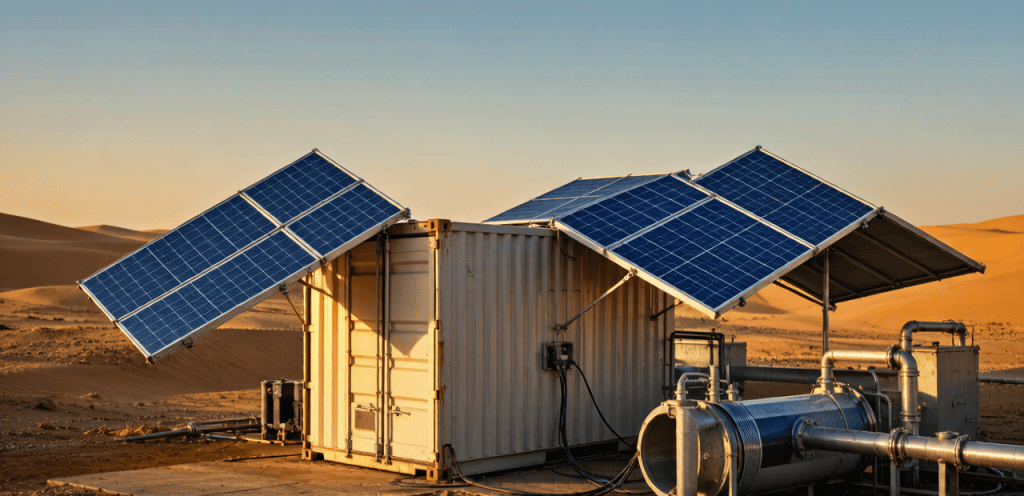
Saudi Arabia operates hundreds of mobile and semi-mobile water treatment stations across its vast territory. From reverse osmosis (RO) desalination units serving remote communities to temporary treatment plants at construction megaprojects and mining camps, these stations share one costly reality: they run entirely on diesel generators, burning 200 to 600 liters of fuel per day. And every 2 to 3 years, the station moves to a new location — taking the diesel dependency with it.
A typical remote water treatment station in Saudi Arabia operates 18-24 hours a day. Water pumps, high-pressure RO membranes, chemical dosing systems, and control instrumentation all demand reliable, uninterrupted power. In off-grid locations, the only option has been diesel.
| Station Capacity | Typical Load | Daily Diesel | Annual Diesel Cost |
|---|---|---|---|
| 50 m³/day (small RO) | 20–30 kW | 150–250 L | SAR 44,000–73,000 |
| 200 m³/day (mid RO) | 40–60 kW | 300–450 L | SAR 88,000–131,000 |
| 500 m³/day (large RO) | 80–120 kW | 500–700 L | SAR 146,000–204,000 |
At SAR 0.80 per liter — and delivered cost to remote sites often considerably higher due to transportation — the fuel bill for a single mid-size water treatment station reaches SAR 100,000+ per year. For operators running multiple stations, this becomes a multi-million-riyal line item. Generator maintenance adds another 15-25% on top.
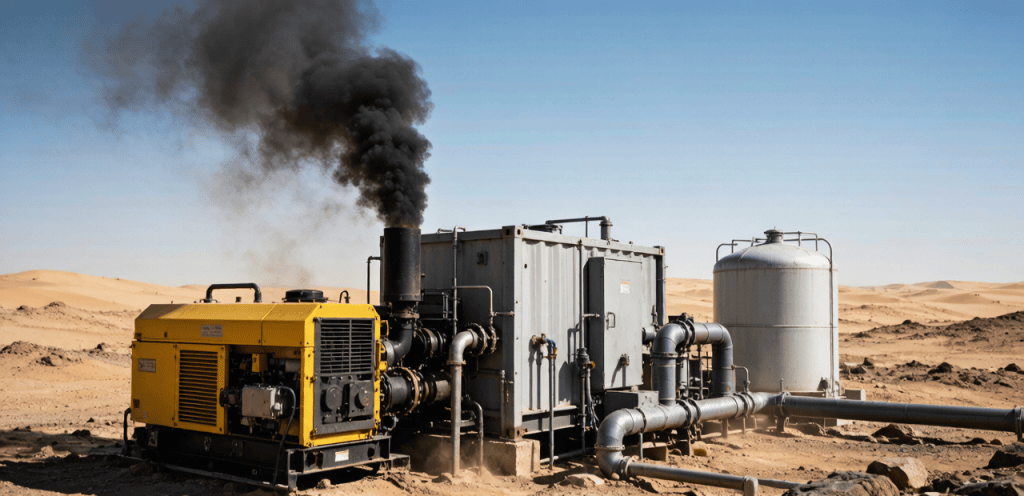
You might ask: why not just install fixed-tilt solar panels at the water station? The answer lies in the 2-to-3-year relocation cycle. Water treatment stations in Saudi Arabia do not stay put:
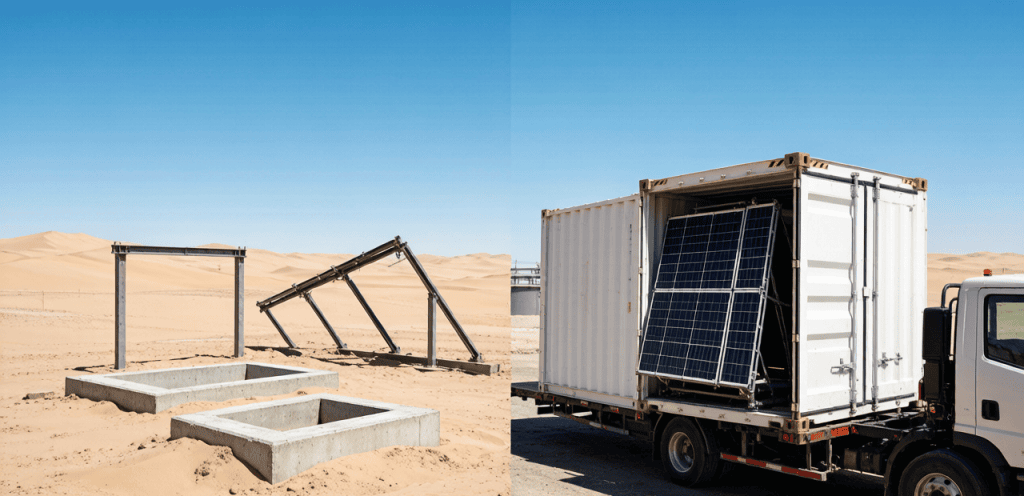
Installing a 60-100 kWp fixed solar array — with concrete foundations, trenching, mounting structures, and DC cabling — costs SAR 200,000-350,000. When the station relocates after 2 years, that investment is entirely stranded. You cannot economically dismantle, transport, and reassemble a ground-mount solar farm. The panels may be reusable, but the civil works, mounting steel, and labor are lost.
This is precisely why most mobile water stations remain 100% diesel-powered — not because solar doesn’t work technically, but because the traditional installation model makes it financially irrational.
VANGE’s ALL IN ONE Foldable Solar-Diesel-Storage Microgrid is engineered specifically for this use case. Everything — high-efficiency LONGI solar panels, LFP battery storage, inverter, EMS controller, and a backup WEICHAI diesel generator — is pre-integrated into a single 20-foot standard shipping container.
When the station arrives on site, the container doors open and the foldable solar wings extend outward — no foundations, no trenching, no crane (a forklift suffices). When it’s time to move, the panels fold back into the container, the unit is loaded onto a flatbed truck, and it arrives at the next site ready to generate power the same day.
This is the critical difference between “solar that works” and “solar that works and moves with you.”
The EMS inside the ALL IN ONE unit continuously optimizes the power mix:
The result: diesel runs 80% fewer hours and consumes 60-80% less fuel. For a 200 m³/day RO station consuming 350 L/day on diesel alone, this drops to approximately 70-140 L/day — saving SAR 60,000-80,000 per year.
Let’s model the economics for a typical 200 m³/day mobile RO desalination station in Saudi Arabia’s Eastern Province or along the Red Sea coast:
| Item | Diesel-Only | ALL IN ONE Hybrid | Annual Saving |
|---|---|---|---|
| Daily diesel consumption | 350 L | 90 L | — |
| Annual diesel cost (SAR 0.80/L) | SAR 102,200 | SAR 26,280 | SAR 75,920 |
| Generator maintenance | SAR 18,000 | SAR 5,000 | SAR 13,000 |
| Gen replacement lifecycle (amortized/yr) | SAR 12,000 | SAR 4,000 | SAR 8,000 |
At a system investment of approximately SAR 200,000-250,000, direct fuel and maintenance savings deliver a payback of 24-30 months. And the key advantage: when the station relocates after year 2 or 3, the ALL IN ONE unit moves with it — continuing to generate savings at the next site with zero re-investment.
Consider a water treatment operator who runs stations on a 3-year rotation cycle across 4 sites over a 12-year period:
The foldable design doesn’t just save fuel — it turns capital expenditure on power infrastructure from a recurring cost into a one-time investment. This is the single biggest financial differentiator for mobile water treatment operators.
| Station Scale | Load | Recommended Unit | PV / Battery / DG |
|---|---|---|---|
| Small (50–100 m³/day) | 20–30 kW | PBD78-60 Compact | 46 kWp / 129 kWh / 50 kW |
| Mid (150–300 m³/day) | 40–60 kW | PBD78-60 Standard | 78 kWp / 128 kWh / 60 kW |
| Large (400–600 m³/day) | 80–120 kW | Custom Multi-Unit | 104–130 kWp / 258+ kWh / 100 kW |
PBD78-60 Specifications (Recommended for mid-size RO stations): 78 kWp LONGI 650Wp bifacial modules, 128 kWh LFP battery (HIGEE cells), 60 kW PORTA PCS inverter, 60 kW WEICHAI diesel generator. 20ft ISO container (6058 × 2438 × 2896 mm), 20,000 kg. Deploys in under 3 hours. Operating temperature: -25°C to 60°C — fully rated for Saudi summer extremes.
Every water treatment station has unique load profiles — RO membrane pressure demands, pump start-up surges, 24/7 vs. daytime-only operation. Tell us about your station and we’ll design the right ALL IN ONE configuration.
Share your station capacity, diesel consumption, and relocation schedule. We'll return a custom configuration with ROI analysis within 48 hours.
📧 jayden@solarstoragediesel.com | 📱 +966 539412006 | Riyadh, Saudi Arabia
Get a customized technical proposal and pricing for our mobile energy solutions.
Tell us about your requirements and we’ll build a solution.
Ask me anything about solar-storage-diesel hybrid microgrids!